
India is known for producing long-grain aromatic rice for international markets, and 1121 Basmati Rice is one of the varieties widely considered by importers, wholesalers, distributors and food-service businesses. Its extra-long grain profile, aroma and cooking characteristics make it suitable for several cuisines and commercial applications.
For bulk buyers, selecting the right processing type is as important as choosing the variety. Steam, Golden Sella and Creamy Sella undergo different processing methods, which influence their colour, texture and cooking performance. Understanding these differences helps buyers specify the right product for their target market. When evaluating 1121 Basmati Rice, importers should compare samples from the exact processing type they intend to purchase.
Before placing a bulk order, importers should confirm the crop year, origin, processing type, average grain length, moisture, broken percentage, packaging and inspection requirements in the purchase contract. These checks help establish whether a particular 1121 Basmati Rice lot meets the buyer’s expectations.
Read More: Indian Rice Varieties for Export
What Makes 1121 Basmati Rice Popular?
The variety is valued for its long, slender grains, characteristic aroma and potential for substantial lengthwise elongation after cooking. These qualities make it a preferred option for biryani, pulao and other rice-based dishes where grain appearance and separation matter.
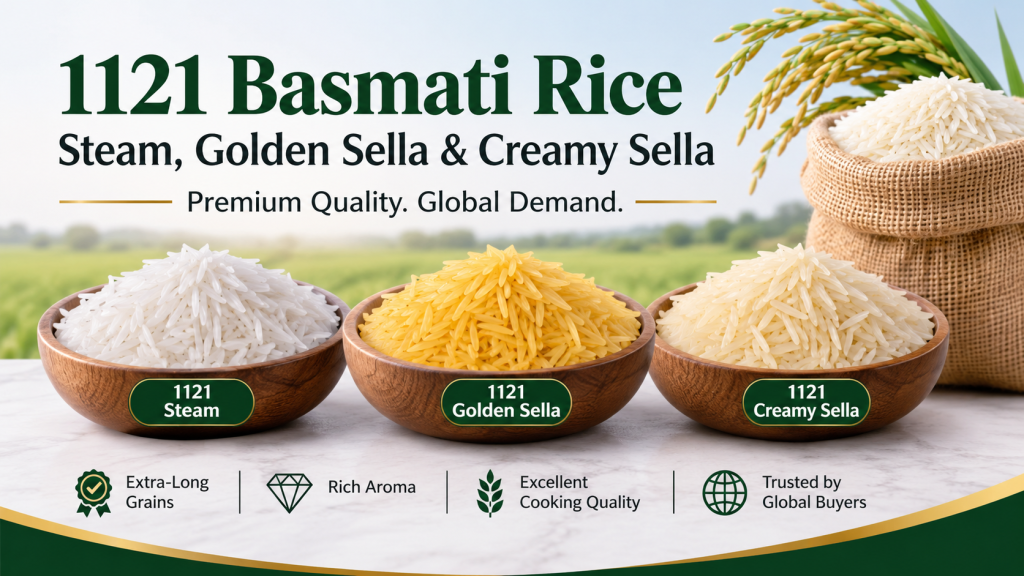
Its suitability for different processing styles also gives buyers flexibility. Depending on the market, customers may prefer the lighter appearance of Steam, the golden shade of Golden Sella or the creamy off-white appearance of Creamy Sella.
Three Main Types of 1121 Basmati Rice
1. 1121 Steam Basmati Rice
Steam processing uses controlled steaming before milling. The finished rice generally retains a white to light creamy appearance and offers the familiar aroma associated with Basmati rice.
Key characteristics:
- White or light creamy grain appearance
- Long, slender grains
- Suitable for biryani, pulao and everyday premium rice applications
- Cooking results depend on ageing, milling, quality and preparation method
Steam rice may suit buyers who prefer a relatively light-coloured product and want the natural Basmati appearance in the finished dish. Buyers sourcing 1121 Basmati Rice in this form should confirm the required grain length and broken percentage before approval.
2. 1121 Golden Sella Basmati Rice
Golden Sella is parboiled before milling. The process changes the grain’s colour, giving it a golden or yellowish appearance. Parboiling also affects the grain structure and cooking behaviour.
Key characteristics:
- Golden or yellowish grain colour
- Firm texture when cooked
- Often selected for large-scale food service and biryani preparation
- Can offer good grain separation when correctly cooked
Buyers should assess the shade, uniformity, aroma, cooking performance and broken percentage of the lot before confirming an order. These details are important when purchasing Golden Sella 1121 Basmati Rice for a specific customer base.
3. 1121 Creamy Sella Basmati Rice
Creamy Sella is also parboiled, but its finished appearance is generally cream or off-white rather than deep golden. It offers an alternative for markets where buyers want parboiled rice with a lighter colour.
Key characteristics:
- Creamy or off-white appearance
- Long grain profile
- Suitable for biryani, catering and bulk food preparation
- Cooking performance depends on processing and lot quality
The preferred shade can vary by buyer and market. Importers should approve a sample or agreed specification before shipment. This is particularly useful when sourcing Creamy Sella 1121 Basmati Rice for repeat orders.
Steam vs Golden Sella vs Creamy Sella: Key Differences
| Feature | Steam | Golden Sella | Creamy Sella |
| Processing | Steamed before milling | Parboiled before milling | Parboiled before milling |
| Typical appearance | White to light creamy | Golden or yellowish | Cream or off-white |
| Buyer preference | Light-coloured Basmati | Golden-coloured parboiled rice | Lighter-coloured parboiled rice |
| Common applications | Biryani, pulao and premium meals | Biryani, catering and food service | Biryani, catering and bulk meals |
These are general product descriptions. Exact colour, cooking characteristics and physical specifications should be confirmed against the supplier’s sample and the agreed contract.
India’s Basmati Rice Export Trend: Last 3 Financial Years
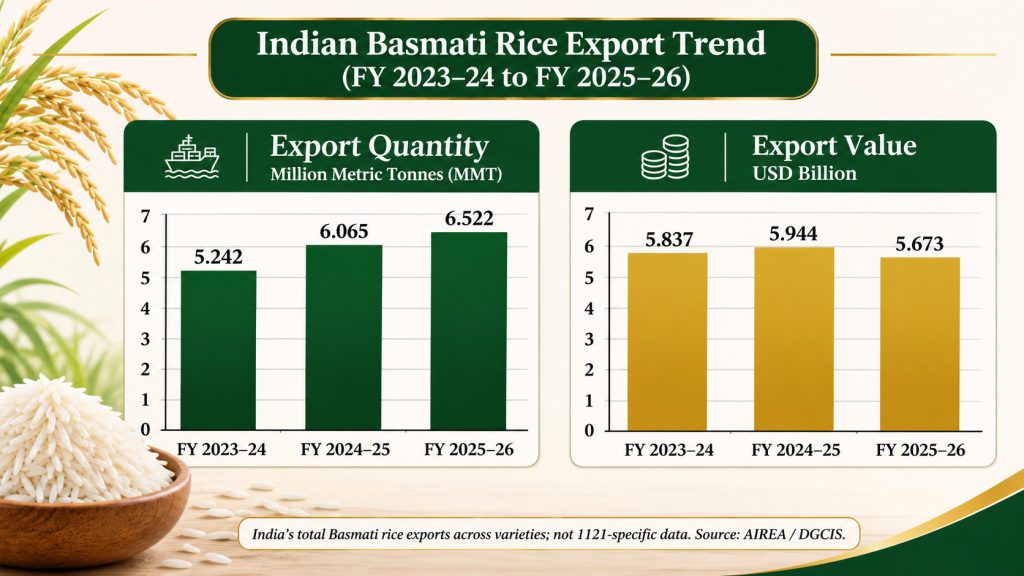
India’s Basmati rice export figures provide useful context for buyers assessing the wider market. According to the All India Rice Exporters’ Association (AIREA), using DGCIS data, export quantity increased over the last three financial years.
Basmati Rice Export Data from India
| Financial Year | Export Quantity (MT) | Export Value (USD Million) |
| 2023–24 | 5,242,049 | 5,837 |
| 2024–25 | 6,065,456 | 5,944 |
| 2025–26 | 6,521,797 | 5,672 |
The quantity exported rose from approximately 5.24 million metric tonnes in FY 2023–24 to 6.52 million metric tonnes in FY 2025–26. Export value, however, increased in FY 2024–25 and then eased in FY 2025–26. This shows why importers should review both volume and value rather than treating either figure as a complete picture of market conditions.
Important: These statistics represent India’s total Basmati rice exports across varieties. They are not specific to 1121 Basmati Rice. Use the graph as an overview of the wider Indian Basmati export market, not as a measure of 1121-only exports.
Important Quality Specifications for Bulk Buyers
Specifications should be finalised according to the destination market, buyer requirements, applicable regulations and the actual lot. A purchase contract should clearly state at least the following:
- Average grain length: Specify the required raw grain length and measurement method. Extra-long grain is a key buying consideration, but measurements can vary by crop, milling and testing method.
- Moisture: Agree on the maximum permitted moisture level. A commonly requested commercial limit may be around 12–13%, but the final figure must be confirmed for the order.
- Broken grains: State the maximum broken percentage and whether it is measured before or after processing.
- Foreign matter: Define the permitted limit for stones, husk, dust and other extraneous material.
- Damaged and discoloured grains: Set acceptable tolerances and colour-uniformity expectations.
- Admixture and purity: Specify whether the buyer requires a particular purity level or restrictions on other varieties.
- Crop year and ageing: Confirm crop year and any ageing requirement where relevant.
Do not rely only on a product name. Ask for a current sample, specification sheet and inspection method so that both parties are working to the same quality standard. This is essential for checking whether the offered 1121 Basmati Rice matches the contracted grade.
Processing, Sorting and Quality Control
Consistent quality requires careful handling at each stage, from procurement to final packing. Buyers can ask suppliers about cleaning, grading, colour sorting, milling controls and storage conditions.
Modern sorting equipment, including optical or Sortex systems where available, can help remove discoloured grains and certain foreign materials. However, equipment alone does not replace inspection. The finished lot should still be checked against the agreed specification.
Good storage practices are equally important. Rice should be kept in clean, dry and well-maintained warehouses, protected from moisture, pests, contamination and odours. Cargo condition should be checked before loading, and containers should be clean, dry and suitable for food cargo.
Packaging and Shipment Options
Bulk buyers can select packaging based on their distribution channel, handling facilities and destination-market requirements. Common options include:
- 25 kg bags
- 50 kg bags
- Buyer-approved printed or unprinted PP bags
- Other customised packaging, subject to order requirements
Before dispatch, confirm bag material, stitching, labelling, net weight, palletisation if required and container loading arrangements. Export shipments may be arranged in 20-foot or 40-foot containers depending on the order quantity, packaging and shipping plan.
Indian shipments may move through ports such as Mundra, Nhava Sheva (JNPT) and Kandla, subject to the supplier’s logistics arrangements, vessel schedules and destination. The final port, Incoterm, shipment window and documentation list should be agreed before the order is confirmed.
Documents and Inspection for Rice Imports
Importers should discuss documentation requirements with their supplier before shipment. The document set may include a commercial invoice, packing list, shipping bill, bill of lading, certificate of origin, phytosanitary certificate or other certificates where required by the destination country and applicable regulations.
Pre-shipment inspection can be arranged when required by the buyer. The inspection scope may cover weight, packaging, moisture, broken percentage, grain appearance, foreign matter and other agreed parameters. Third-party inspection can also be considered where the contract or importing country’s rules require it.
Requirements differ by destination. Buyers should verify current import rules with their customs broker or competent authority rather than assuming that the same certificates apply in every country.
How to Choose the Right 1121 Basmati Rice Supplier
A reliable supplier should be able to explain the product clearly and provide consistent communication throughout the order process. For bulk 1121 Basmati Rice purchases, product knowledge and transparent specifications are especially important.
Before choosing a partner, consider these points:
- Product knowledge: The supplier should explain the differences between Steam, Golden Sella and Creamy Sella and help match the type to your market.
- Clear specifications: Confirm grain length, moisture, broken percentage, purity, crop year and tolerances in writing.
- Sample approval: Review a representative sample before finalising a bulk order.
- Quality systems: Ask about cleaning, sorting, inspection and storage practices.
- Packaging flexibility: Check whether the supplier can meet your bag size, printing and labelling requirements.
- Export documentation: Confirm the supplier understands the documents and compliance requirements for your destination.
- Shipment coordination: Agree on the port, loading period, Incoterm and communication process.
These checks can reduce misunderstandings and help importers compare quotations on a like-for-like basis.
How Mega Grain Supports Bulk Rice Buyers
Mega Grain is an India-based agricultural commodity trading and global trade facilitation company with 36 years of experience. The company works across rice, pulses, spices, cereals and other agricultural commodities, connecting buyers and suppliers in international markets.
For buyers sourcing 1121 Basmati Rice, Mega Grain can assist with product discussions, variety and processing-type selection, specification coordination, quality checks, packaging requirements, documentation coordination and shipment planning. The team can discuss buyer requirements for different 1121 Basmati Rice processing types and shipment sizes.
The company focuses on clear communication, competitive sourcing, quality coordination, documentation support, timely loading arrangements and organised delivery processes. Buyers can discuss Steam, Golden Sella and Creamy Sella requirements based on their market preferences.
Mega Grain Offices & Contact Details
Head Office:
402, Prabhat Kiran Building,
Rajendra Place, New Delhi – 110008, India
Phone: +91-11 25719896 – 97
Phone: +91-9555899006
Email: info@megagrain.com
Website: www.megagrain.com
Contact Persons
- Neeraj Dhawan
- Radhika Dhawan
- Kritika Dhawan
Conclusion
Choosing the right Basmati rice involves more than selecting a variety. Importers should understand the differences between Steam, Golden Sella and Creamy Sella, then confirm grain quality, processing, moisture, broken percentage, packaging and destination-specific documentation.
India’s overall Basmati export trend provides useful market context, while the final buying decision for 1121 Basmati Rice should be based on the specific variety, sample and contract specifications. By checking these details and working with an experienced trade partner, bulk buyers can plan their sourcing and shipments with greater clarity.