
India supplies a wide range of spices to international markets, including cumin, coriander, turmeric, chilli, fennel, fenugreek and cardamom. For importers, purchasing spices involves more than agreeing on product specifications, quantity and price. The shipment must also meet customs procedures, food-safety requirements and the documentation rules of the destination country.
Understanding Indian Spice Export Documentation helps importers prepare for customs clearance, verify shipment details and avoid unnecessary delays. Each document serves a different purpose, from identifying the exporter and declaring the goods to confirming their origin, transport details and compliance status.
The exact paperwork depends on the spice, destination, transport method, buyer’s requirements and payment terms. Some documents are part of the standard export process, while others are required only for particular products or markets.
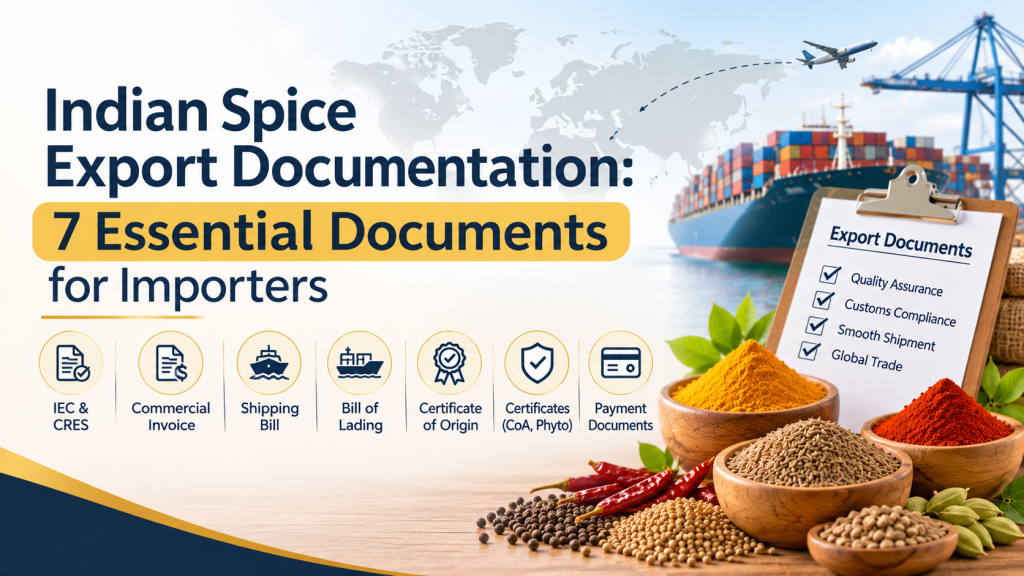
This guide explains seven important document groups that international buyers should understand when sourcing spices from India.
Read More: Why Indian Spices are in High Demand Worldwide
Why Export Documentation Matters in Spice Trade
Spices are food products, so their international movement may involve customs, food-safety, agricultural and other regulatory checks. Importers need accurate information about the product, its origin, quantity, packaging and quality.
Proper Indian Spice Export Documentation helps the exporter and importer coordinate these requirements before the cargo is dispatched. It also supports payment processing, cargo tracking and verification of the shipment.
A document discrepancy can create problems even when the physical product meets the agreed specifications. Differences in product descriptions, weights, consignee details or origin information may require corrections and can affect clearance.
1. Importer-Exporter Code (IEC) and CRES Registration
Before exporting spices from India, the exporter must have the relevant business registrations in place.
The Importer-Exporter Code (IEC), issued by the Directorate General of Foreign Trade (DGFT), is a key registration for businesses undertaking import or export activities. For spices and spice products, the Spices Board states that a Certificate of Registration as Exporter of Spices (CRES) is also mandatory, in addition to IEC.
CRES is issued by the Spices Board under the applicable regulatory framework. Exporters apply through the online registration process.
Importers dealing with a new supplier can ask for confirmation of the supplier’s relevant registration details.
Important points to verify:
- Valid IEC details.
- Applicable CRES registration.
- Correct legal name and business details.
- Whether the exporter is registered as a merchant or manufacturer exporter.
- Whether any relevant registration needs renewal or amendment.
For Indian Spice Export Documentation, these registrations establish the exporter’s eligibility and provide an important starting point for checking the business before a transaction proceeds.
2. Commercial Invoice and Packing List
The commercial invoice and packing list provide essential information about the goods being sold and shipped. In India, a commercial invoice-cum-packing list may be used where the applicable customs procedure permits it.
The commercial invoice records the financial and contractual details of the transaction. It normally includes:
- Exporter and importer details.
- Invoice number and date.
- Product description.
- HS code, as applicable.
- Quantity and unit of measurement.
- Unit price and total value.
- Currency.
- Agreed Incoterms.
- Payment terms.
The packing list provides details about how the goods are packed. It may include the number of bags, net weight, gross weight, package dimensions and marks or identification numbers.
For example, a shipment of cumin, turmeric or coriander should have a product description that matches the purchase order and agreed specifications. If the cargo contains different spice varieties or grades, the packing details should clearly distinguish them.
Accurate Indian Spice Export Documentation requires consistency between the invoice, packing list, shipping declaration and transport document. Importers should review these details before the exporter submits the shipment for customs clearance.
3. Shipping Bill
The shipping bill is the principal customs declaration used for export shipments from India by sea or air. For exports by land, the applicable declaration is generally a bill of export.
The exporter or its authorised customs broker files the shipping bill electronically through the customs system. It contains information about the exporter, consignee, goods, quantity, value, port and applicable export declarations.
Customs may assess the declaration and examine the cargo where required. Once the necessary formalities are completed, Customs grants the Let Export Order (LEO), allowing the goods to proceed for export.
Importers should understand the shipping bill because it forms part of the customs record for the shipment.
Check that:
- The exporter and consignee details are correct.
- The product description and HS classification are appropriate.
- Declared quantity and value match the commercial documents.
- The port and shipment details are accurate.
- The applicable customs clearance status is confirmed.
The shipping bill is an important part of Indian Spice Export Documentation, but it is not a substitute for product-specific certificates that may be required by the importing country.
4. Bill of Lading or Airway Bill
The transport document provides evidence that the carrier has received the cargo for transportation. The document used depends on the mode of shipment.
Bill of Lading (B/L): Generally issued for sea freight, it records the shipment and the terms of carriage. Depending on its type, it may also function as a document of title.
Airway Bill (AWB): Used for air freight as evidence of the contract of carriage and receipt of the goods. It is generally not a document of title in the same way as a negotiable bill of lading.
The transport document typically identifies the shipper, consignee, carrier, origin, destination, package count, cargo description and shipment details.
Importers should check:
- Consignee and notify-party information.
- Port of loading and destination.
- Number of packages.
- Cargo description and weight.
- Container or shipment reference.
- Freight terms and other agreed details.
For sea shipments of bulk spices, the bill of lading is especially important for coordinating cargo release and delivery at the destination. Its details should match the invoice and packing list.
5. Certificate of Origin
A Certificate of Origin (CoO) identifies the country in which the goods originate. It may be requested by the importing country’s customs authorities, the buyer or the bank handling the export payment.
The certificate can help determine whether the shipment qualifies for preferential tariff treatment under an applicable trade agreement. The correct certificate type and issuing authority depend on the destination and the relevant trade arrangement.
Importers should confirm the following before shipment:
- Whether a Certificate of Origin is required.
- Whether a preferential or non-preferential certificate is needed.
- Which issuing authority is accepted.
- Whether any supporting origin evidence is required.
- Whether the product description and exporter details match the other documents.
A Certificate of Origin should not be confused with a quality certificate. It confirms origin, not the product’s purity, moisture or food-safety status.
When reviewing Indian Spice Export Documentation, buyers should confirm the origin requirements early, especially when a shipment may qualify for tariff benefits under a trade agreement.
6. Certificate of Analysis, Phytosanitary and Other Product-Specific Certificates
Spices may be subject to additional regulatory or buyer-specific requirements because they are agricultural food products. These documents are not automatically required for every spice shipment. Their applicability depends on the product, processing condition, importing country and intended use.
Important examples include:
Certificate of Analysis (COA)
A COA provides laboratory results for specified quality or safety parameters. Depending on the buyer’s requirements, testing may cover moisture, foreign matter, pesticide residues, heavy metals, microbiological parameters, aflatoxins or other relevant contaminants.
Phytosanitary Certificate
This certificate is issued by the authorised plant-health authority when required by the importing country. It confirms that the consignment meets the applicable plant-health requirements.
Health or Food-Safety Certificate
Certain markets or buyers may require a health certificate or other official food-safety documentation. The precise requirement should be checked for the product and destination.
Inspection or Fumigation Certificate
A buyer, importing authority or contract may require an inspection report or fumigation certificate. The need for these documents depends on the cargo and applicable rules.
Importers should not assume that one certificate covers every requirement. A COA, for example, does not replace a phytosanitary certificate when the destination authority specifically requires one.
This is one of the most important areas of Indian Spice Export Documentation because requirements can differ between whole spices, ground spices and processed spice products.
7. Payment and Bank-Related Documents
Export documentation also supports the financial side of the transaction. The documents required depend on the payment arrangement agreed between the buyer and seller.
For shipments under a Letter of Credit (LC), the exporter must prepare documents in accordance with the LC terms. Even small differences in names, dates, descriptions or shipment details may lead to discrepancies during document examination.
Common payment-related documents include:
- Letter of Credit, where applicable.
- Bill of Exchange, where required.
- Commercial invoice.
- Packing list.
- Bill of Lading or Airway Bill.
- Insurance document, where required by the contract or LC.
- Electronic Bank Realisation Certificate (eBRC), for applicable export-proceeds reporting and related processes.
The exporter should coordinate with its authorised dealer bank and follow the applicable foreign-exchange and reporting procedures. The importer should also ensure that its payment instructions and document requirements are communicated before shipment.
For Indian Spice Export Documentation, this step connects the physical movement of the goods with the commercial and banking obligations of both parties.
Common Documentation Mistakes Importers Should Avoid
Many export-documentation problems can be prevented through early review and clear communication. International buyers should avoid these common mistakes:
- Sharing incomplete or incorrect consignee details.
- Using inconsistent product descriptions across documents.
- Not confirming the correct HS classification.
- Ignoring destination-specific food-safety requirements.
- Assuming every spice requires the same certificates.
- Leaving Certificate of Origin requirements until dispatch.
- Not checking LC terms before shipment.
- Failing to review weights, package counts and invoice values.
- Not confirming who is responsible for arranging each certificate.
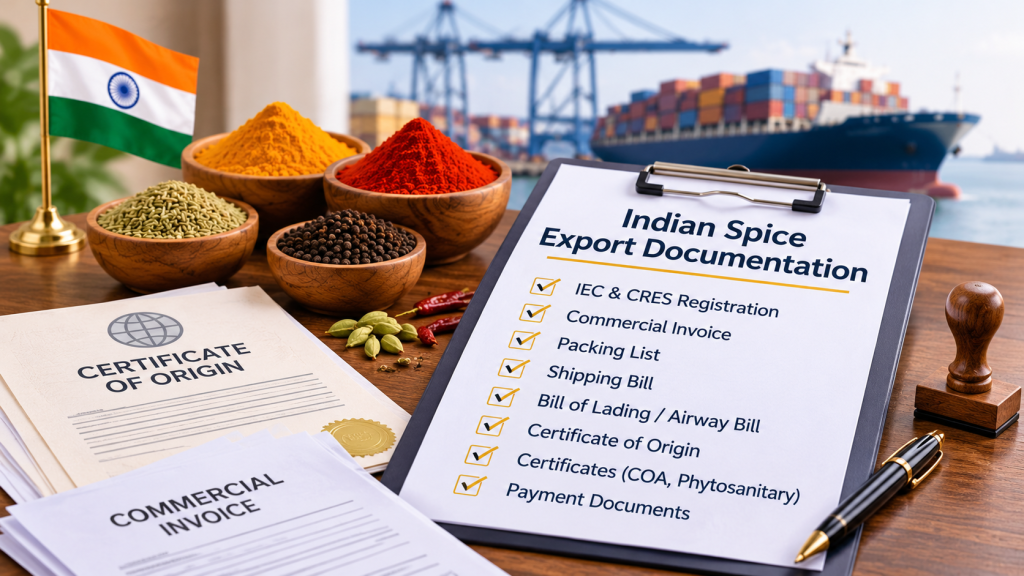
A document checklist agreed between the buyer, exporter, freight forwarder and customs broker can help reduce these issues.
How Mega Grain Supports Spice Trade Coordination
Mega Grain works in the physical trading and facilitation of agricultural commodities, connecting buyers with sourcing networks and supporting trade coordination. Its product categories include rice, pulses, spices, cereals, edible oils, dry fruits and sugar.
For international buyers sourcing spices from India, Mega Grain can assist with requirement coordination, supplier verification, product specifications, documentation discussions and shipment planning.
Buyers can share the spice variety, required quantity, destination country, packaging preference, quality parameters and any specific certificates requested by their importing authority. This information helps the team understand the transaction and coordinate the relevant requirements.
Documentation, product availability, testing arrangements, prices and shipment schedules should be confirmed for each individual order.
Mega Grain Offices & Contact Details
Head Office:
402, Prabhat Kiran Building,
Rajendra Place, New Delhi – 110008, India
Phone: +91-11 25719896 – 97
Phone: +91-9555899006
Email: info@megagrain.com
Website: www.megagrain.com
Contact Persons
- Neeraj Dhawan
- Radhika Dhawan
- Kritika Dhawan
Conclusion
Successful spice imports depend on accurate documentation as much as on product quality and shipment planning. Importers should understand the exporter’s IEC and CRES registration, commercial invoice, packing list, shipping bill, transport document, Certificate of Origin, product-specific certificates and payment-related paperwork.
The requirements are not identical for every shipment. Buyers should confirm the latest rules with the relevant authorities, customs broker and banking partners before dispatch.
A clear understanding of Indian Spice Export Documentation helps importers prepare their requirements, review shipment records and coordinate more effectively with suppliers. Establishing these checks before the order is shipped can support smoother customs clearance and more dependable international trade.