
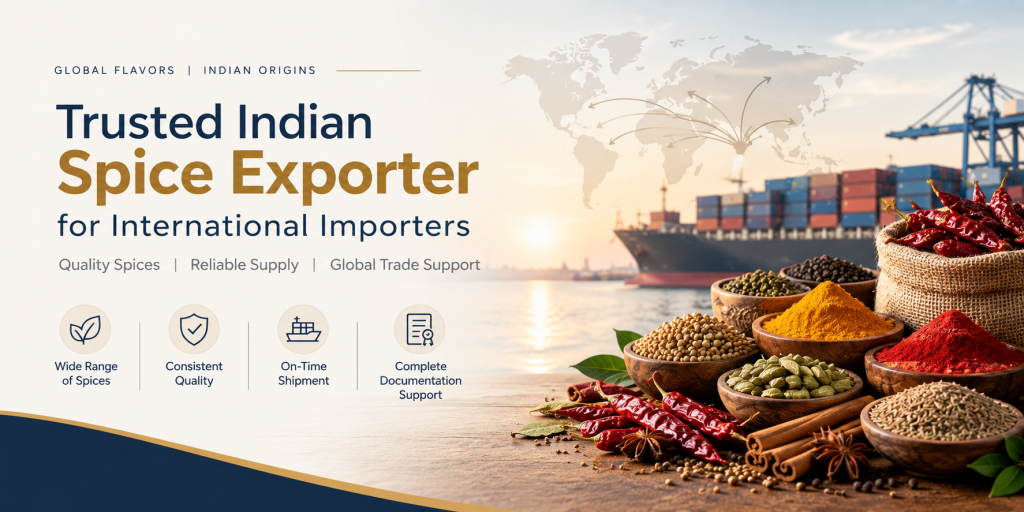
Trusted Indian Spice Exporter for International Importers
Finding the right supplier is one of the most important decisions for an international spice buyer. Product quality, consistency, packaging, documentation, testing, and shipment coordination can all influence the success of an import order.
A trusted Indian spice exporter should offer more than a competitive quotation. International importers need a sourcing partner who understands product specifications, quality expectations, commercial quantities, and the practical requirements involved in cross-border agricultural trade.
India’s wide range of spices makes the country an important sourcing destination for wholesalers, distributors, food manufacturers, retailers, and commodity traders around the world.
Read More: Why Indian Spices are in High Demand Worldwide
Why International Buyers Source Spices from India
India has a diverse agricultural base and a long-established spice industry. Different regions produce and supply spices with varying characteristics, grades, sizes, colours, and applications.
International buyers can source a broad range of Indian spices, including:
- Cumin
- Coriander
- Fennel
- Fenugreek
- Turmeric
- Red chilli
- Cardamom
- Sesame
- Other whole and processed spice products
The right product depends on the buyer’s application, required specifications, quantity, destination, and applicable import requirements.
For commercial buyers, India’s product diversity can make it possible to source multiple agricultural commodities while working with clearly defined specifications for each order.
What Makes a Trusted Indian Spice Exporter?
Reliability in international spice trade is built through several factors rather than one single feature.
Consistent Product Quality
Consistency is essential for buyers who use spices as raw materials for food production, seasoning, processing, or distribution.
Depending on the product, buyers may specify:
- Moisture
- Colour
- Size
- Grade
- Purity
- Foreign matter
- Cleanliness
- Aroma
- Pungency where applicable
These specifications should be discussed before the commercial order is confirmed.
Clear Product Specifications
A professional sourcing process should be based on measurable requirements rather than general descriptions such as “premium” or “best quality.”
Buyers should clearly communicate the product, variety, grade, quantity, packaging, testing requirements, and destination before finalizing the transaction.
This creates a common reference for both the importer and supplier.
Product Knowledge
Different spices have different characteristics and quality parameters. Cumin, turmeric, cardamom, red chilli, coriander, and other products cannot always be evaluated using the same criteria.
A supplier with good product knowledge can better understand buyer requirements and coordinate suitable specifications for the intended application.
Reliable Communication
International transactions involve multiple parties and several stages.
A supplier should communicate clearly regarding:
- Product availability
- Price and commercial terms
- Specifications
- Sample approval
- Testing
- Packaging
- Cargo readiness
- Documentation
- Shipment schedules
Clear communication helps buyers maintain better visibility throughout the order process.
Indian Spices for International Markets
Indian spices are used across food manufacturing, seasoning, restaurants, retail products, beverages, confectionery, sauces, spice blends, and other food applications.
The requirements of an importer can therefore vary considerably.
For example, a food manufacturer may require a specific grade and laboratory testing, while a wholesaler may focus more on packaging, quantity, consistency, and delivery schedules.
This is why Indian spice sourcing should begin with understanding the buyer’s actual application rather than simply selecting a product from a catalogue.
Popular Indian Spices Available for Commercial Sourcing
Cumin
Cumin is widely used in food processing, seasoning, spice blends, and culinary products. Buyers may specify seed size, purity, moisture, cleanliness, and other quality parameters according to their requirements.
Coriander
Coriander is used in spice blends, food products, seasoning, and culinary applications. International buyers can define requirements for whole or processed coriander depending on the intended use.
Fennel
Fennel is commonly used in food products, seasoning, spice blends, and traditional preparations. Buyers may specify size, appearance, colour, cleanliness, and packaging requirements.
Fenugreek
Fenugreek is used in spice blends, food products, and traditional applications. Commercial buyers should confirm grade, quality parameters, packaging, and destination requirements before placing an order.
Turmeric
Turmeric is valued for its colour, flavour, and use in food products and spice blends. Buyers should confirm the required form, grade, colour, purity, and applicable testing requirements.
Red Chilli
Indian red chilli is available in different varieties with varying colour, size, and pungency characteristics.
Mega Grain’s available varieties include:
- Teja Chilli
- Mundu Chilli
- 5531 Chilli
- Tomato Chilli
- Mahi Chilli
- Armour Chilli
- Yellow Chilli
- Kashmiri Chilli
The suitable variety depends on the buyer’s application and required specifications.
Cardamom
Cardamom is used in beverages, confectionery, food products, spice blends, and culinary applications. Buyers may specify size, appearance, colour, aroma, and packaging.
Sesame
Sesame is used in bakery products, food processing, seasoning, and other commercial applications. Importers should discuss purity, moisture, foreign matter, packaging, and destination requirements before shipment.
Quality Control and Testing
Quality assurance should be considered before a bulk shipment is prepared.
Depending on the product and destination, quality checks may include:
- Moisture
- Foreign matter
- Purity
- Colour
- Product size or grade
- Microbiological parameters
- Pesticide residues
- Aflatoxin
- Pungency where relevant
- Other destination-specific food-safety parameters
The exact requirements can vary according to the spice, importing country, buyer specifications, and applicable regulations.
For certain spice products and destinations, additional sampling or testing requirements may apply. International importers should therefore confirm the applicable requirements before cargo preparation.
A trusted Indian spice exporter should be able to discuss these requirements with buyers and coordinate the applicable quality process according to the order.
Why Sample Approval Is Important
Sample approval provides a practical quality reference before a large commercial quantity is prepared.
The buyer may assess the sample for:
- Appearance
- Colour
- Aroma
- Size
- Grade
- Cleanliness
- Moisture
- Pungency where applicable
- Other agreed parameters
Once the sample is approved, the bulk order can be prepared against the agreed specifications.
This can be particularly useful for food manufacturers and distributors because variations in raw-material quality can affect production and finished products.
Packaging for International Spice Shipments
Packaging protects the product during handling, transportation, and storage.
The suitable packaging format depends on the product, quantity, transportation method, buyer requirements, and destination.
Before cargo preparation, importers should confirm:
- Packaging material
- Bag size
- Net weight
- Number of bags
- Labelling requirements
- Pallet requirements where applicable
- Container loading instructions
- Storage and handling requirements
Packaging decisions should be finalized early so that the shipment can be prepared according to the agreed requirements.
Documentation for International Importers
Documentation is an important part of international spice trade.
Depending on the product and destination, shipments may require commercial, shipping, inspection, phytosanitary, fumigation, origin, or other regulatory documentation.
Common documents may include:
- Commercial invoice
- Packing list
- Certificate of Origin
- Bill of Lading
- Phytosanitary certificate where applicable
- Fumigation certificate where applicable
- Inspection or laboratory reports where required
- Export and regulatory documentation
- Other documents requested by the importing country or buyer
Requirements can vary between countries and products, so documentation should be discussed before the shipment is finalized.
Why Shipment Coordination Matters
International commodity trade does not end when the goods are packed.
Cargo readiness, container arrangements, loading, port coordination, documentation, and shipping schedules all need to be managed properly.
Good shipment coordination helps importers maintain better visibility over their orders and can reduce avoidable delays.
For businesses purchasing commercial quantities, logistics coordination is an important part of a dependable supplier relationship.
How International Importers Can Select the Right Supplier
Price is important, but it should not be the only consideration when choosing a supplier.
Review the Product Specifications
Buyers should make sure that the supplier understands the required variety, grade, size, purity, moisture, colour, and other relevant parameters.
Check Sample Quality
Where appropriate, buyers should review and approve a sample before confirming a large commercial order.
Discuss Testing Requirements
The required quality and food-safety tests should be established according to the product, buyer specifications, and destination market.
Confirm Packaging
Packaging material, bag size, weight, labelling, and loading requirements should be agreed before cargo preparation.
Verify Documentation
Importers should confirm which commercial and regulatory documents are required for their destination.
Evaluate Communication
Timely communication about pricing, availability, samples, documentation, and shipment status can make international procurement easier to manage.
Consider Long-Term Supply
Wholesalers, distributors, and manufacturers often require repeat supplies. A supplier’s ability to support commercial quantities and maintain consistency can therefore be more valuable than a one-time low quotation.
Common Mistakes Spice Importers Should Avoid
Choosing Only on Price
The cheapest quotation does not necessarily provide the lowest overall procurement cost. Quality issues, delays, rejected cargo, and additional handling costs can increase the final expense.
Not Defining Quality Clearly
General terms such as “premium quality” can create different expectations. Buyers should use measurable specifications wherever possible.
Skipping Sample Approval
Bulk purchasing without reviewing a suitable sample can increase the risk of receiving goods that do not meet the expected requirements.
Ignoring Destination Regulations
Import requirements can differ between countries. Buyers should confirm applicable testing, documentation, labelling, and food-safety requirements before shipment.
Finalizing Packaging Too Late
Last-minute packaging changes can create delays and additional costs. Packaging should be agreed during the order-planning stage.
Poor Shipment Communication
A lack of updates about cargo readiness, loading, documentation, or shipping schedules can make international procurement unnecessarily difficult.
Why Choose Mega Grain for Global Spice Sourcing?
Mega Grain is an India-based agricultural commodity trading and global trade facilitation group with more than 36 years of industry experience.
The company focuses on connecting global commodity markets and coordinating requirements between international buyers and suitable suppliers.
Mega Grain can coordinate sourcing for products including:
- Cumin
- Fennel
- Coriander
- Fenugreek
- Turmeric
- Sesame
- Red chilli
- Cardamom
For buyers seeking a trusted Indian spice exporter, Mega Grain focuses on understanding product requirements, coordinating suitable specifications, supporting documentation, and helping manage shipment-related requirements.
The sourcing approach is designed around clear buyer requirements rather than simply offering a standard product catalogue.
Mega Grain also supports communication between buyers and suppliers throughout the commercial process, helping international importers coordinate product specifications, samples, quality expectations, packaging, documentation, and shipment planning.
With more than 36 years of industry experience, the objective is to develop dependable commodity relationships that can support both individual orders and long-term sourcing requirements.
Mega Grain Offices & Contact Details
Head Office:
402, Prabhat Kiran Building,
Rajendra Place, New Delhi – 110008, India
📞 +91-11 25719896 – 97
📞 +91-9555899006
📧 info@megagrain.com
🌐 www.megagrain.com
Contact Persons
- Neeraj Dhawan
- Radhika Dhawan
- Kritika Dhawan
Conclusion
Choosing a trusted Indian spice exporter requires more than comparing quotations. International importers should evaluate product quality, specifications, testing, sample approval, packaging, documentation, communication, and shipment coordination.
A reliable Indian spice supplier should understand the practical requirements of international commodity trade and provide clear communication from enquiry to shipment.
For buyers sourcing Indian spices in commercial quantities, the right trade partner can help create a more organized and dependable procurement process. Mega Grain combines more than 36 years of industry experience with supplier coordination and global commodity trade support to help international buyers source Indian agricultural products.