
Indian red chilli is an important ingredient in food manufacturing, spice blends, sauces, seasonings and processed food products. For international buyers, sourcing dried red chilli in bulk involves more than comparing prices. Buyers need to evaluate heat level, colour, moisture, cleanliness, pesticide residues, processing, packaging and destination-market regulations before confirming an order.
India has a well-established chilli supply chain and exports dried red chilli to a wide range of international markets. However, different buyers require different varieties and specifications. A chilli suitable for a hot spice blend may not meet the colour, size or pungency requirements of a sauce manufacturer.
For importers planning Indian Red Chilli Export purchases, a clear specification and dependable sourcing process can help reduce quality disputes, shipment delays and unnecessary costs.
Read More: Why Indian Spices are in High Demand Worldwide
India’s Red Chilli Export Market: Recent Trends
Chilli is one of the largest contributors to India’s spice export earnings. According to Spices Board India data, chilli accounted for approximately 27% of the value of India’s spice export basket in FY 2025–26. This percentage refers to the overall spice basket, not the share of chilli exports going to a particular country.
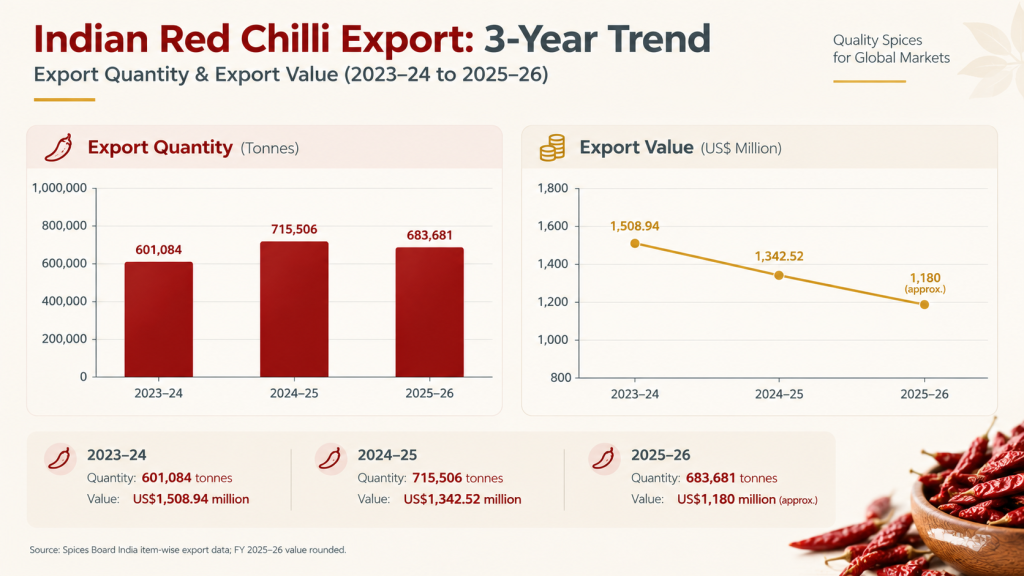
Recent Indian Chilli Export Performance
| Financial Year | Export Quantity | Export Value |
| 2023–24 | 601,084 tonnes | US$1,508.94 million |
| 2024–25 | 715,506 tonnes | US$1,342.52 million |
| 2025–26 | 683,681 tonnes | US$1,180 million approximately |
Source: Spices Board India item-wise export figures and FY 2025–26 trade reporting. Values are rounded where indicated.
The figures show that chilli export volume rose strongly in 2024–25 before easing in 2025–26. Export value also declined over the latest period. This highlights an important point for importers: higher shipment volumes do not automatically mean higher export earnings. Prices, crop conditions, demand, product mix and destination-market requirements can all influence trade value.
Important Markets for Indian Red Chilli
Indian spices are exported to markets including China, the USA, the UAE, Bangladesh, Saudi Arabia, Thailand, Malaysia, Indonesia and several European countries. These are destinations for the overall Indian spice basket; the exact ranking and requirements for dried chilli differ by product form and trade year.
For bulk chilli buyers, the most useful approach is to confirm the intended destination, product specification and applicable regulations before finalizing the purchase.
7 Key Factors for Bulk Importers
1. Choose the Right Chilli Variety
Variety selection is one of the first decisions in bulk sourcing because different chillies offer different combinations of heat, colour, size and appearance.
Mega Grain’s available red chilli varieties include:
- Teja
- Mundu
- 5531
- Tomato
- Mahi
- Armour
- Yellow
- Kashmiri
Each variety should be assessed against the buyer’s intended application. For example, a buyer prioritizing pungency may require a different specification from a manufacturer that values strong red colour or a particular chilli shape.
Importers should state the required variety, product form and end use when requesting quotations. They should also ask whether the supplier can maintain the same specification across repeat shipments.
2. Define Heat Level, Colour and Physical Specifications
The term “red chilli” is not a complete buying specification. Importers should identify the characteristics that matter for their product.
Important parameters can include:
- Pungency or heat level
- Colour and colour consistency
- Length and size
- Moisture content
- Foreign matter
- Damaged or discoloured pods
- Stem content
- Broken pods
- Product form: whole, crushed or ground
Pungency may be assessed through an agreed laboratory method, while colour can be evaluated using suitable analytical or buyer-approved methods. The precise requirements depend on the destination and the chilli’s intended use.
For Indian Red Chilli Export, documenting these parameters before placing the order gives both parties a common basis for quality assessment.
3. Check Cleanliness, Purity and Processing
Dried chillies can contain stems, dust, plant material or other foreign matter if they have not been adequately cleaned. These impurities may affect processing efficiency, usable yield and the final product’s appearance.
A reliable bulk-sourcing process should include:
- Cleaning and sorting
- Removal of unwanted material
- Grading according to buyer specifications
- Inspection of damaged or discoloured pods
- Batch-wise quality checks
- Hygienic handling and storage
Depending on the specification, mechanical cleaning or Sortex processing may help improve product consistency. Buyers should confirm which processing steps are included in the quotation rather than assuming that every supplier offers the same level of preparation.
4. Prioritize Food Safety and Pesticide-Residue Testing
Food safety is essential when sourcing dried chilli for international markets. Importing countries may apply specific limits for pesticide residues and contaminants, and buyers should confirm which requirements apply to the product and destination.
Depending on the market and end use, testing may cover:
- Pesticide residues
- Aflatoxins where applicable
- Heavy metals where required
- Microbiological parameters
- Moisture
- Other destination-specific contaminants
Importers should agree on the sampling method, testing laboratory and acceptable limits before shipment. If a certificate of analysis is required, confirm which parameters it must cover and whether the destination authority recognizes the testing arrangement.
For Indian Red Chilli Export, the supplier’s ability to coordinate appropriate testing and provide traceable batch information can be as important as the physical appearance of the chilli.
5. Verify the Origin, Crop and Lot Consistency
Crop conditions can influence chilli size, colour, availability and price. Buyers placing recurring orders should discuss the sourcing region and how the supplier manages variation between lots.
Useful questions include:
- What is the declared origin of the chilli?
- Is the product from a single variety or a mixed lot?
- Can the supplier provide representative samples?
- How is the lot inspected before dispatch?
- Can the same specification be maintained for future orders?
A sample should be evaluated against the agreed specification, not simply approved based on general appearance. For repeat purchases, buyers can retain a reference sample and compare it with subsequent consignments.
6. Confirm Packaging and Export Documentation
Packaging must protect the product during handling, storage and transit. The appropriate option depends on the buyer’s requirements, shipping route and destination regulations.
Before confirming an order, importers should agree on:
- Bag material and weight
- Food-grade packaging where required
- Inner lining where appropriate
- Stitching and sealing
- Product and batch labelling
- Palletization if required
- Container cleanliness
- Moisture protection
Export documents may include a commercial invoice, packing list, Bill of Lading, Certificate of Origin, Certificate of Analysis and inspection or phytosanitary documents where applicable. Requirements vary by destination and product form, so the final list should be confirmed before loading.
Spice exporters should also verify the applicable registration and export requirements with the relevant Indian authorities. Spices Board India identifies CRES—Certificate of Registration as Exporter of Spices—as mandatory for the export/import of spices and spice products.
7. Plan Shipment, Storage and Cargo Handling
A good-quality chilli consignment can still face problems if cargo handling is inadequate. Containers should be clean, dry and free from unwanted odours or contamination. Packaging should be inspected before loading, and the cargo should be protected against moisture during transit.
Bulk buyers should confirm:
- Shipment quantity and loading plan
- Container type and condition
- Loading supervision
- Shipping route and estimated transit time
- Required inspection before dispatch
- Document preparation and sharing
- Procedures for reporting any quality discrepancy
For ongoing supply programmes, buyers should also discuss lead times and how future orders will be coordinated around availability and specification requirements.
Common Mistakes Bulk Chilli Importers Should Avoid
Choosing only on price: A low quotation may reflect a different variety, heat level, colour standard or cleaning specification.
Using vague specifications: Words such as “premium” or “export quality” should be supported by measurable requirements.
Skipping sample approval: A representative sample can help buyers confirm whether the product meets their intended use.
Ignoring destination rules: Requirements differ between markets, so testing and documentation should be agreed before shipment.
Overlooking storage and loading: Moisture, contamination and unsuitable packaging can damage product quality during transit.
Not planning repeat orders: Buyers with regular production needs should discuss future availability and consistency from the beginning.
Why Choose Mega Grain for Indian Red Chilli Sourcing?
Mega Grain is an India-based agricultural commodity trading and global trade facilitation group with more than 36 years of experience across spices, pulses, cereals, rice, edible oils, dry fruits, sugar and other agricultural commodities.
For buyers considering Indian Red Chilli Export, Mega Grain helps connect international buyers with suitable Indian supply sources based on their required variety, specifications and destination-market needs.
Our sourcing approach focuses on:
- Buyer-specific product specifications
- Suitable chilli varieties
- Quality and purity checks
- Cleaning, grading and Sortex processing where required
- Laboratory testing coordination where required
- Hygienic storage and suitable packaging
- Documentation support
- Pre-shipment inspection
- Loading and cargo coordination
- Consistent sourcing support
The aim is to help buyers establish a reliable procurement process for their particular requirements rather than simply arrange a one-time transaction.
Mega Grain Offices & Contact Details
Head Office:
402, Prabhat Kiran Building,
Rajendra Place, New Delhi – 110008, India
📞 +91-11 25719896 – 97
📞 +91-9555899006
📧 info@megagrain.com
🌐 www.megagrain.com
Contact Persons
- Neeraj Dhawan
- Radhika Dhawan
- Kritika Dhawan
Conclusion
Bulk chilli sourcing requires a clear understanding of variety, heat level, colour, cleanliness, testing, packaging, documentation and shipment handling. Evaluating these factors before placing an order can help importers reduce quality disputes and make supplier comparisons more reliable.
India’s established chilli supply chain gives international buyers access to a range of product types and sourcing options. However, the best purchasing decision depends on matching the product to the buyer’s application and destination-market requirements.
For buyers planning Indian Red Chilli Export purchases, a detailed specification and dependable sourcing partner can help create a more consistent and manageable international supply chain.