
Turmeric is one of India’s most important agricultural spices, used across food manufacturing, spice blends, seasoning, nutraceuticals, traditional products and value-added ingredients. For international buyers, however, sourcing turmeric in bulk is not simply about comparing prices. Product quality, curcumin content, cleanliness, pesticide residues, processing, documentation and destination-market compliance all influence the success of an import order.
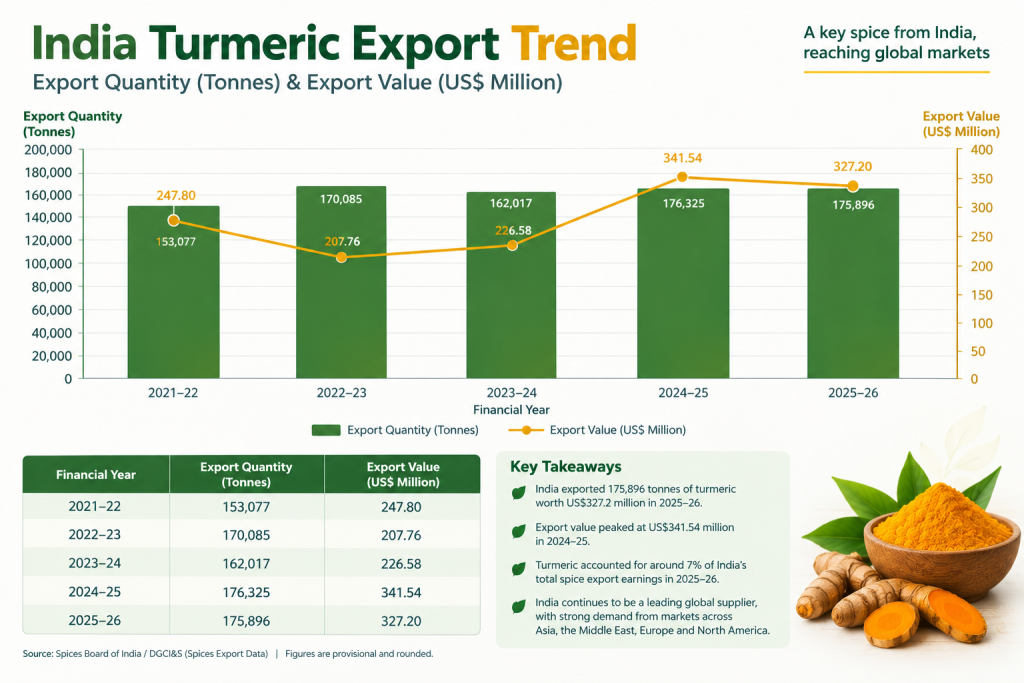
India has a strong position in the global turmeric trade. In FY 2025–26, India exported approximately 175,896 tonnes of turmeric valued at US327.2million,whileFY2024–25recorded176,325tonnesvaluedatUS341.54 million.
For importers considering Indian Turmeric Export, understanding the quality and compliance requirements before placing a bulk order can help reduce rejection risks, quality claims and shipment delays.
Read More: Why Indian Spices are in High Demand Worldwide
India’s Turmeric Export Market: Recent Trend
India is a major producer, consumer and exporter of turmeric and turmeric-based products. Spices Board India has stated that India accounts for around 67% of global turmeric export volume and around 66% of global export value based on its 2024–25 figures.
Recent Turmeric Export Performance
| Financial Year | Export Quantity | Export Value |
| 2021–22 | 153,077 tonnes | US$247.80 million |
| 2022–23 | 170,085 tonnes | US$207.76 million |
| 2023–24 | 162,017 tonnes | US$226.58 million |
| 2024–25 | 176,325 tonnes | US$341.54 million |
| 2025–26 | 175,896 tonnes | US$327.20 million |
The latest data shows that export volume remained almost stable between FY 2024–25 and FY 2025–26, while export value declined by around 4%. This shows how international commodity prices and market conditions can change even when shipment volumes remain relatively steady.
During FY 2025–26, turmeric represented approximately 7% of India’s total spice export earnings. The broader Indian spice basket was exported to major destinations including the USA, China, UAE, Bangladesh, Saudi Arabia, the UK, Thailand, Malaysia, Indonesia, Germany, the Netherlands, Canada, Nepal and Australia.
These destination figures refer to India’s overall spice exports, not turmeric-specific destination shares. Individual turmeric markets can have different product specifications, testing requirements and import regulations.
For buyers evaluating Indian Turmeric Export, the market trend provides useful context, but product quality and compliance remain the key factors when selecting a supplier.
7 Essential Quality & Compliance Factors for Importers
1. Define the Turmeric Grade and Intended Application
Before requesting quotations, importers should clearly define what type of turmeric they require.
Turmeric may be purchased in different forms, including:
- Whole turmeric fingers
- Dried turmeric
- Polished turmeric
- Turmeric powder
- Processed turmeric
- Higher-curcumin grades
- Turmeric for food manufacturing
- Turmeric for nutraceutical or ingredient applications
The required specification depends heavily on the final use.
For example, a spice processor may prioritize colour, aroma, cleanliness and grinding performance, while an ingredient manufacturer may focus more heavily on curcumin percentage and analytical parameters.
A clear specification should include the required form, moisture, foreign matter, curcumin level where applicable, colour, size, microbial limits and destination-specific compliance requirements.
This makes supplier comparisons more meaningful because buyers are comparing the same product specification rather than simply comparing prices.
2. Check Curcumin Content and Product Consistency
Curcumin is one of the most important quality parameters for many turmeric buyers.
Different turmeric origins and grades can naturally show differences in curcumin concentration. Therefore, buyers should not assume that all turmeric has the same specification.
For bulk purchasing, importers should establish:
- Minimum curcumin requirement
- Testing method
- Acceptable variation between lots
- Required colour characteristics
- Whole-finger or powder specification
- Batch identification and traceability
If turmeric is being purchased for a specialized food, nutraceutical or ingredient application, the curcumin specification should be agreed before the commercial contract is finalized.
A lot that meets the buyer’s visual expectations may still fail an analytical specification, so laboratory testing should support the physical inspection.
For Indian Turmeric Export, a clearly defined curcumin specification can also help suppliers identify the right grade before processing and quotation.
3. Verify Cleanliness, Purity and Processing
Physical cleanliness is essential for imported turmeric.
Raw agricultural commodities can contain soil, stones, plant material, dust or other unwanted matter if they are not properly cleaned and processed.
A professional turmeric sourcing process should therefore include:
- Cleaning
- Sorting
- Grading
- Removal of foreign matter
- Appropriate polishing where required
- Hygienic processing
- Batch inspection
- Proper storage
Spices Board India specifically notes that product quality depends on raw material as well as processing, packing, storage and transportation. Its turmeric quality guidance also emphasizes care from pre-harvest operations through to the point where the product reaches consumers.
For an importer, this means the supplier’s processing facility and handling procedures are just as important as the appearance of the raw turmeric.
4. Prioritize Pesticide-Residue and Food-Safety Compliance
Food-safety compliance is one of the most important parts of international turmeric sourcing.
Importing countries may apply their own maximum residue limits and testing requirements. A turmeric consignment can therefore meet a supplier’s internal specification and still require additional compliance checks for the destination country.
Buyers should discuss testing requirements for parameters such as:
- Pesticide residues
- Microbiological parameters
- Aflatoxins where applicable
- Heavy metals where required
- Ethylene oxide where applicable
- Other destination-specific contaminants
Spices Board India states that turmeric is checked for pesticide residues by importing countries and advises that pesticides banned in importing countries should not be used.
Japan is one example of why destination-specific compliance matters. Spices Board reported that turmeric exported from India to Japan was brought under inspection/testing requirements for each consignment under Japan’s food-safety framework, including testing related to foods containing turmeric.
For importers, the practical lesson is simple: confirm the destination-market testing requirements before the cargo is processed and shipped.
5. Check Moisture, Storage and Shelf Stability
Moisture is another critical consideration for bulk turmeric.
Poorly dried or improperly stored turmeric can experience quality deterioration, mould growth, odour changes or other problems during storage and transportation.
Before purchasing, buyers should confirm:
- Maximum moisture specification
- Drying practices
- Warehouse conditions
- Ventilation
- Protection from humidity
- Pest-control procedures
- Storage duration
- Container-loading conditions
The supplier should be able to explain how turmeric is stored after processing and how the product is protected until shipment.
For long-distance international trade, this becomes particularly important because the product may spend weeks in containers before reaching the buyer.
Good storage practices can protect both the physical quality of the turmeric and the commercial value of the shipment.
6. Confirm Documentation and Export Compliance
Quality alone does not guarantee a successful shipment. The documentation must also be correct.
For spice exports from India, buyers should work with suppliers who understand the applicable registration, documentation and destination requirements.
Spices Board India states that a Certificate of Registration as Exporter of Spices (CRES) is mandatory for the export/import of spices and spice products.
Depending on the transaction and destination, documentation may include:
- Commercial invoice
- Packing list
- Bill of Lading
- Certificate of Origin
- Phytosanitary documentation where applicable
- Certificate of Analysis
- Inspection certificate where required
- Fumigation certificate where applicable
- Food-safety or health-related certificates where required
- Product-specific declarations
Importers should provide their documentation requirements before shipment rather than requesting additional certificates after the cargo has already been loaded.
For Indian Turmeric Export, documentation should be treated as part of the sourcing process rather than as an administrative step at the end of the transaction.
7. Choose Suitable Packaging and Cargo Handling
The final factor is often overlooked: packaging and shipment handling.
Turmeric can be supplied in packaging selected according to the buyer’s requirements, shipment size and destination. Bulk buyers may require PP bags, woven sacks, food-grade bags or customized private-label packaging depending on the application.
Before loading, buyers should confirm:
- Bag size and weight
- Food-grade packaging
- Inner lining where required
- Proper stitching/sealing
- Labelling requirements
- Container cleanliness
- Moisture protection
- Palletization requirements where applicable
- Fumigation requirements
- Loading supervision
The container itself should be clean, dry and free from contamination or odour.
For international shipments, cargo handling is part of quality management. Even a well-tested turmeric lot can suffer problems if exposed to moisture, contamination or poor storage conditions during transit.
Major Mistakes Turmeric Importers Should Avoid
Bulk buyers can reduce unnecessary risks by avoiding several common mistakes.
Choosing only by price:
The cheapest quotation may not represent the same curcumin level, processing standard, testing or packaging specification.
Using vague product descriptions:
Terms such as “premium turmeric” should be replaced with measurable specifications.
Skipping laboratory testing:
Visual inspection alone cannot confirm pesticide residues, curcumin content or many other analytical parameters.
Ignoring destination regulations:
A specification suitable for one country may not automatically meet another country’s requirements.
Leaving documentation until the last minute:
Certificates and testing requirements should be agreed before shipment.
Failing to check storage conditions:
The condition of the product after processing is important, but so is the way it is stored before loading.
These mistakes can create unnecessary costs for importers, particularly when a shipment has already been dispatched and a quality or compliance issue is discovered at destination.
Why Choose Mega Grain for Indian Turmeric Sourcing?
Mega Grain is an experienced India-based agricultural commodity trading and global trade facilitation group with more than 36 years of experience across spices, pulses, cereals, rice, edible oils, dry fruits, sugar and other agricultural commodities.
For international buyers looking for Indian Turmeric Export, Mega Grain helps connect buyers with suitable Indian supply sources based on their required product specifications and destination-market needs.
Our sourcing approach focuses on:
- Verified commodity suppliers
- Buyer-specific specifications
- Quality and purity checks
- Processing and grading requirements
- Laboratory testing where required
- Hygienic storage
- Suitable bulk packaging
- Documentation support
- Pre-shipment inspection
- Loading and cargo supervision
- Shipment coordination
- Consistent sourcing support
The goal is to help importers build a dependable supply chain rather than simply arrange a one-time transaction.
Mega Grain Offices & Contact Details
Head Office:
402, Prabhat Kiran Building,
Rajendra Place, New Delhi – 110008, India
📞 +91-11 25719896 – 97
📞 +91-9555899006
📧 info@megagrain.com
🌐 www.megagrain.com
Contact Persons
- Neeraj Dhawan
- Radhika Dhawan
- Kritika Dhawan
Conclusion
Successful turmeric sourcing requires more than finding a competitive quotation. Importers need to evaluate the product specification, curcumin content, cleanliness, moisture, testing, documentation, packaging and destination-market compliance before confirming a bulk order.
India’s strong position in the international turmeric market provides buyers with access to established production and supply networks. FY 2025–26 exports of 175,896 tonnes valued at US$327.2 million demonstrate the scale of India’s turmeric trade.
For buyers considering Indian Turmeric Export, the best approach is to establish clear specifications at the beginning and work with a sourcing partner that understands both product quality and international trade requirements.
With proper testing, documentation, processing and cargo management, Indian turmeric can become a dependable component of an international spice supply chain.