
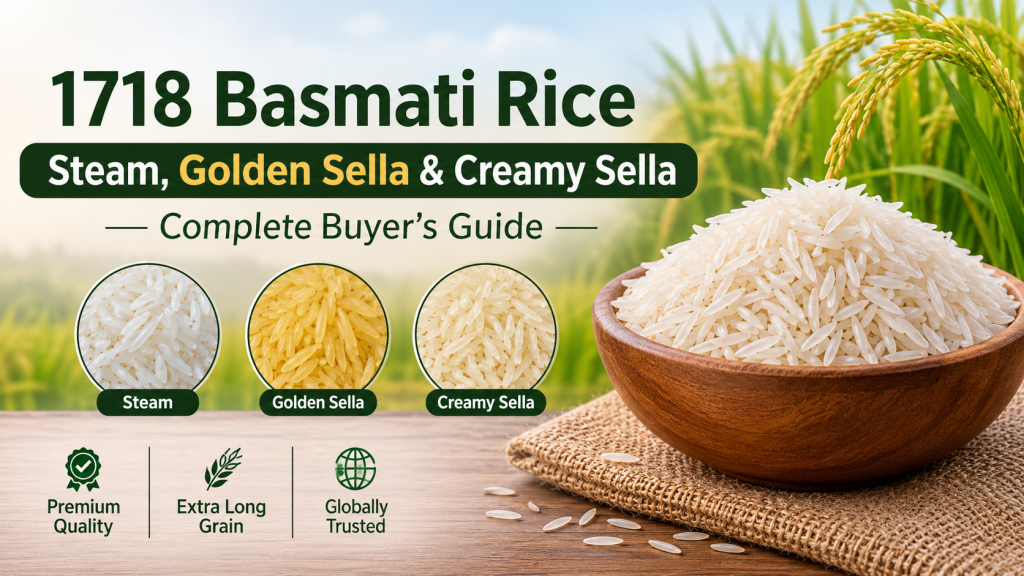
Indian Basmati rice is valued in international markets for its distinctive aroma, long slender grains, delicate flavour and cooking characteristics. Among the varieties available to bulk buyers, 1718 Basmati Rice is an option worth evaluating for importers, wholesalers, distributors and food-service businesses looking for consistent grain quality.
It is commercially available in different processing forms, including Steam, Golden Sella and Creamy Sella. Each form has its own appearance, processing characteristics and cooking behaviour. Understanding these differences helps buyers select the right product for their market and customer requirements.
This guide explains the three forms, important quality parameters, processing standards, packaging options and export considerations for bulk purchases.
Read More: Indian Rice Varieties for Export
1. Understanding 1718 Basmati Rice
The 1718 variety is traded in the Indian Basmati market and is available in different processing forms to meet the requirements of international buyers. The final characteristics of a shipment depend on paddy quality, milling, processing, ageing, sorting and the specifications agreed between the buyer and supplier.
Buyers should assess more than the variety name when placing an order. Grain length, moisture, broken percentage, aroma, colour, purity and cooking performance all influence the suitability of a shipment.
Before confirming a bulk order, importers should request a representative sample and approve the agreed specifications in writing.
2. Three Main Processing Forms
The three commonly requested forms are Steam, Golden Sella and Creamy Sella. Although they originate from the same rice variety, their processing methods create differences in colour, texture and cooking performance.
Steam Basmati Rice
Steam processing involves treating the paddy with steam before milling. This process helps preserve the natural characteristics of the rice while influencing grain strength and cooking behaviour.
Key characteristics:
- Generally retains a natural white or off-white appearance
- Suitable for buyers who prefer a lighter-coloured rice
- Offers a separate, elongated grain appearance when cooked correctly
- Used in biryani, pulao and other rice-based dishes
- Requires careful milling and sorting to maintain uniformity
Steam rice is often considered by importers supplying retail markets, restaurants and food-service businesses that prefer a relatively natural grain appearance.
Golden Sella Basmati Rice
Golden Sella is produced through parboiling, a process in which paddy is soaked and treated with heat before drying and milling. This processing method gives the rice its characteristic golden or yellowish colour.
Key characteristics:
- Golden or yellowish grain appearance
- Firm grain structure
- Generally offers good resistance to breakage during handling and cooking
- Suitable for biryani and large-scale food preparation
- Popular in markets where golden-coloured parboiled rice is preferred
Golden Sella is worth considering for buyers who prioritise firm cooked grains and a distinctive golden appearance.
Creamy Sella Basmati Rice
Creamy Sella is another parboiled form. It generally has a cream or pale ivory appearance rather than the stronger golden shade associated with Golden Sella.
Key characteristics:
- Creamy or pale ivory grain colour
- Parboiled processing
- Firm texture when cooked according to the product specification
- Suitable for biryani, catering and bulk food-service applications
- Offers an alternative for buyers who prefer a lighter parboiled appearance
The exact colour and cooking characteristics can vary according to the paddy, processing conditions and milling standards.
3. Steam vs Golden Sella vs Creamy Sella
Importers should compare the three forms according to their target market instead of selecting only by appearance.
| Parameter | Steam | Golden Sella | Creamy Sella |
| Processing | Steam-treated | Parboiled | Parboiled |
| Typical appearance | White/off-white | Golden/yellowish | Cream/pale ivory |
| Grain structure | Depends on milling and batch | Generally firm | Generally firm |
| Common applications | Biryani, pulao, retail | Biryani, catering | Biryani, catering |
| Buyer preference | Natural lighter appearance | Golden colour | Lighter parboiled colour |
The best choice depends on customer expectations, local cooking practices, price positioning and the specifications required by the importer.
4. Important Quality Specifications for Bulk Buyers
Quality specifications should be confirmed before a purchase contract is finalised. The following parameters are useful when evaluating a shipment:
Grain length: Buyers should specify the required average grain length and whether the measurement refers to raw or cooked rice. The supplier should provide a sample and supporting specifications.
Broken percentage: The permitted broken percentage should be agreed in the contract. Different buyers may require different grades depending on their retail or food-service market.
Moisture content: Moisture should remain within the agreed commercial and destination-market limits. Excess moisture can affect storage stability and product condition.
Foreign matter: Stones, husk, dust and other unwanted material should be controlled through cleaning and sorting.
Damaged and discoloured grains: The buyer should specify acceptable limits for damaged, discoloured and immature grains.
Admixture: The shipment should meet the agreed purity and admixture requirements.
Aroma and cooking quality: Buyers should evaluate the sample for natural aroma, texture, elongation and cooking performance.
There is no single specification that applies to every order. The final quality sheet should reflect the buyer’s requirements, destination regulations and the agreed product grade.
5. Processing, Sorting and Quality Control
A consistent export shipment depends on the complete processing chain, starting from paddy selection and ending with final packing.
A professional rice-processing operation should include:
- Raw material inspection: Paddy is checked for quality and suitability before processing.
- Cleaning: Unwanted materials are removed before milling and further treatment.
- Processing: Steam or parboiling methods are selected according to the buyer’s order.
- Milling and polishing: Rice is milled and finished according to the required grade.
- Sortex sorting: Optical sorting helps remove discoloured and defective grains.
- Final inspection: The finished product is checked against the agreed specifications.
- Packing and dispatch: Approved rice is packed, labelled and prepared for shipment.
Mega Grain gives importance to quality verification, appropriate processing, Sortex sorting, hygienic storage and cargo maintenance as part of its commodity supply process.
6. Packaging Options for International Orders
Packaging should be selected according to the destination market, distribution channel and buyer’s storage requirements.
Common bulk packaging options include:
- 5 kg and 10 kg consumer packs
- 20 kg and 25 kg bags
- 50 kg PP bags
- Buyer-specific private-label packaging, subject to agreement
Importers should confirm bag material, stitching, printing, labelling, net weight and packaging specifications before production.
For container shipments, the loading plan should consider container type, bag dimensions, stacking arrangement, cargo protection and the agreed shipment quantity. Packaging must also comply with the importing country’s applicable food-label and packaging regulations.
7. Export Documentation and Shipment Planning
A smooth international shipment requires accurate documentation and coordination between the supplier, buyer, freight forwarder, customs broker and relevant authorities.
Depending on the transaction and destination, the documentation may include:
- Commercial Invoice
- Packing List
- Shipping Bill
- Bill of Lading
- Certificate of Origin, where required
- Phytosanitary or inspection documents, where applicable
- Fumigation certificate, where required
- Quality or laboratory certificate, as agreed
Rice exporters in India must also follow applicable APEDA registration and export requirements. Destination-country regulations can differ, so buyers should confirm the latest import conditions before shipment.
Indian rice shipments commonly move through major ports such as Mundra, Kandla and Nhava Sheva, depending on the supplier’s location, shipping line and buyer’s destination.
Before dispatch, both parties should confirm the shipment schedule, Incoterms, payment terms, inspection requirements, loading plan and required documents.
8. What Buyers Should Check Before Placing a Bulk Order
A clear purchase process helps reduce misunderstandings and quality disputes.
International buyers should:
- Confirm the exact variety and processing form.
- Request a recent product sample.
- Approve the grain length and broken percentage.
- Confirm moisture, foreign matter and admixture limits.
- Agree on colour, aroma and cooking expectations.
- Finalise packaging and bag printing.
- Confirm the quantity and shipment schedule.
- Decide whether pre-shipment or third-party inspection is required.
- Verify destination-country import and labelling requirements.
- Confirm payment terms and shipping responsibilities.
For repeat orders, buyers should maintain an approved specification sheet and compare every new shipment against the agreed standard.
9. Why Work with Mega Grain?
Mega Grain is an India-based agricultural commodity trading and global trade facilitation group with more than 36 years of experience in physical commodity trading.
The company works across rice, pulses, spices, cereals, edible oils, dry fruits and other agricultural commodities. Its approach focuses on connecting international buyers with suitable supply sources and coordinating key stages of the trade process.
For rice requirements, Mega Grain supports buyers with:
- Product and specification coordination
- Quality verification and supplier coordination
- Processing and sorting requirements
- Packaging discussions based on buyer needs
- Export documentation coordination
- Shipment planning and loading follow-up
- Communication throughout the trade process
Buyers looking for 1718 Basmati Rice can discuss the required processing form, grade, quantity, packaging and destination before finalising a commercial order. Product availability and specifications should be confirmed for each shipment.
10. Three-Year Indian Basmati Export Trend
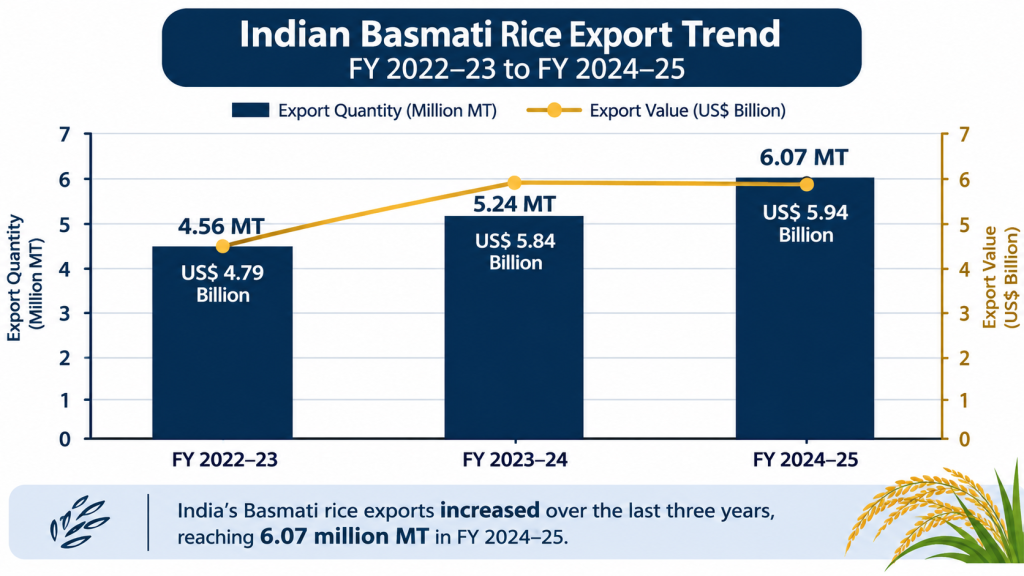
India’s Basmati rice export performance provides useful background for international buyers assessing the wider market. The following figures show the country’s total Basmati rice exports, rather than exports of any one variety.
| Financial Year | Export Quantity | Export Value |
| 2022–23 | 4.56 million MT | US$4.79 billion |
| 2023–24 | 5.24 million MT | US$5.84 billion |
| 2024–25 | 6.07 million MT | US$5.94 billion |
The data indicates that India’s Basmati export quantity increased across all three financial years. Export value also increased, although the rate of growth differed from the rise in volume.
For importers, these figures provide market context. They should not be interpreted as 1718-specific export volumes, because the published national totals include multiple Basmati varieties.
Graph data:
- FY 2022–23: 4.56 million MT
- FY 2023–24: 5.24 million MT
- FY 2024–25: 6.07 million MT
Conclusion
Choosing the right Basmati rice involves more than selecting a variety name. Processing method, grain appearance, cooking performance, quality specifications, packaging and shipment requirements all influence the final buying decision.
Steam, Golden Sella and Creamy Sella serve different buyer preferences. Importers should compare samples, approve specifications and confirm documentation before placing a bulk order.
Mega Grain works with international commodity buyers to coordinate rice requirements, quality expectations, packaging and shipment planning. Contact the team to discuss your required grade, processing form and bulk quantity.
Mega Grain Offices & Contact Details
Head Office:
402, Prabhat Kiran Building,
Rajendra Place, New Delhi – 110008, India
📞 +91-11 25719896 – 97
📞 +91-9555899006
📧 info@megagrain.com
🌐 www.megagrain.com
Contact Persons
- Neeraj Dhawan
- Radhika Dhawan
- Kritika Dhawan