
India is a major source of spices for international food manufacturers, wholesalers, distributors and seasoning companies. From cumin, coriander and fennel to turmeric, chilli and fenugreek, Indian spices are used in a wide range of food products and cuisines. For international buyers, however, purchasing spices in bulk involves more than comparing prices and confirming quantities. Product identity, cleanliness, moisture, aroma, food safety and packaging all influence the quality of a shipment.
When sourcing Bulk Indian Spices, importers should establish clear specifications before confirming an order. Different spices have different physical characteristics and quality requirements, so a single inspection approach cannot be applied to every product. Buyers should assess each item according to its intended use, destination-market regulations and agreed commercial specifications.
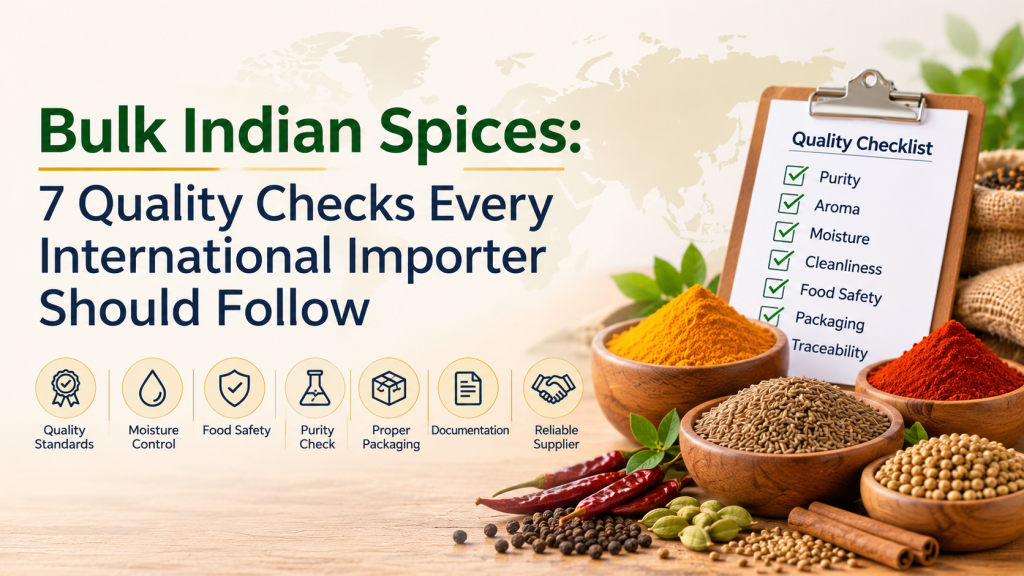
Working with a supplier that understands sourcing, processing, quality checks and export coordination can make procurement more organised. The following seven checks can help international importers evaluate suppliers and reduce avoidable quality risks.
Read More: Why Indian Spices are in High Demand Worldwide
1. Verify Spice Identity, Origin and Grade
The first step is to confirm exactly what is being purchased. Spices may be offered in whole, ground, crushed, cleaned, machine-sorted or processed forms. Buyers should specify the product name, variety, grade, origin and processing condition in their purchase requirements.
For example, whole cumin seeds and cumin powder have different inspection requirements. Similarly, turmeric fingers and turmeric powder cannot be evaluated using identical physical criteria.
Ask the supplier to provide:
- Exact product and variety name.
- Country and region of origin, where available.
- Grade or commercial specification.
- Whole, crushed or powdered form.
- Crop or production season, where traceable.
- Intended application and buyer-specific requirements.
For Bulk Indian Spices, origin information is particularly useful when buyers need consistent product characteristics or want to maintain traceability across repeat purchases.
India’s spice-producing regions have different growing conditions and crop profiles. A supplier should be able to explain the sourcing network and clarify whether a shipment comes from one production area or has been consolidated from multiple lots.
2. Inspect Appearance, Colour, Aroma and Physical Condition
Visual and sensory inspection can help identify obvious quality issues before a shipment is approved. Each spice has its own natural colour, aroma, texture and physical appearance. Buyers should compare the offered sample with the agreed product specification rather than relying on a general description such as premium quality.
Important checks include:
- Natural and characteristic colour.
- Fresh, characteristic aroma.
- Uniformity in size and appearance, where relevant.
- Presence of broken, immature or damaged material.
- Signs of insect activity or deterioration.
- Unusual odour, discolouration or visible mould.
For whole spices, buyers may also examine seed or pod condition, size distribution and the amount of broken material. For powdered spices, colour consistency, texture and the possibility of adulteration require particular attention.
A representative sample should be collected from the actual lot being offered. Buyers should approve the sample against written specifications and establish how the final shipment will be checked.
A professional supplier of Bulk Indian Spices should be able to explain the product’s natural characteristics and identify any variation that may occur between lots.
3. Check Moisture Content and Storage Conditions
Moisture is an important quality parameter because unsuitable moisture levels can affect the condition of spices during storage and transportation. Excess moisture may encourage mould growth, caking, deterioration and changes in aroma. Very dry material may also become brittle or lose some of its desirable characteristics, depending on the product.
The acceptable moisture level is not the same for every spice. Buyers should define the required limit according to the product, applicable standard, intended use and destination-market regulations.
Before confirming an order, ask for:
- Moisture specification for the product.
- Test results for the offered lot.
- Testing method or laboratory details.
- Storage conditions before dispatch.
- Measures taken to prevent moisture absorption.
- Protection against rain, humidity and condensation during handling.
Storage facilities should be clean, dry, ventilated and protected from pests. Spices should be kept away from strong odours and materials that could affect their aroma or condition.
For buyers importing Bulk Indian Spices, checking moisture and storage practices before shipment can help prevent quality problems that may become visible only after the cargo reaches its destination.
4. Verify Purity and Foreign-Matter Limits
Purity is one of the most important considerations in bulk spice procurement. Foreign matter may include dust, stones, soil, stalks, unwanted plant material, other seeds and miscellaneous particles. The permitted limits depend on the spice and the buyer’s specification.
Importers should not assume that all suppliers use the same definition of cleaned or machine-cleaned material. The cleaning process and final acceptance criteria should be discussed in advance.
Ask the supplier to clarify:
- Foreign-matter limits.
- Admixture limits, where applicable.
- Broken or damaged material tolerance.
- Cleaning and grading methods.
- Availability of sieving or optical sorting.
- Inspection procedures before packing.
Processing may include mechanical cleaning, grading, sieving and Sortex or optical sorting, depending on the product and required specification. These operations can improve consistency, but buyers should still verify the final result through sampling or inspection.
A reliable supplier should be able to explain how purity is checked and what happens if the shipment does not meet the agreed specification.
5. Review Food Safety and Laboratory Testing
Physical appearance alone cannot establish that a spice is safe for consumption. International buyers should consider the food-safety requirements of the importing country and the intended application.
Depending on the spice and destination, testing may be required for:
- Pesticide residues.
- Heavy metals.
- Microbiological parameters.
- Aflatoxins or other relevant mycotoxins.
- Undeclared colours or adulterants.
- Other contaminants specified by the buyer or importing authority.
The applicable limits and test requirements vary by product and market. Buyers should therefore confirm the latest requirements with their importer, customs broker or regulatory adviser before placing an order.
Ask for a Certificate of Analysis (COA), where applicable, and check that it identifies the correct product and batch. If third-party testing is required, agree on the laboratory, sampling method and responsibility for the inspection cost.
When purchasing Bulk Indian Spices, importers should also ask about the supplier’s food-safety practices, hygiene procedures and traceability arrangements. A certificate should relate to the actual lot being supplied; a general company certificate is not a substitute for batch-specific test results.
6. Assess Processing, Hygiene and Batch Traceability
The supplier’s processing arrangements can influence the consistency of the final product. Buyers should understand how spices are received, cleaned, sorted, processed and packed.
A suitable processing facility should have procedures to reduce contamination risks and maintain product identity throughout handling. Equipment should be maintained, and cleaning procedures should be followed to prevent unwanted material from entering the product.
Useful questions include:
- Is the product processed in a dedicated or controlled area?
- Are cleaning and sorting procedures documented?
- How are different lots identified and stored?
- Are pest-control and hygiene procedures in place?
- Can the supplier trace the lot back to its procurement source?
- Are inspection and processing records available?
Batch identification is especially important for repeat orders and quality complaints. It allows the buyer and supplier to refer to a specific lot instead of discussing the product in general terms.
For Bulk Indian Spices, traceability and documented handling procedures provide greater clarity when buyers need to review a shipment or arrange future procurement.
7. Confirm Packaging, Labelling and Export Documentation
Even a good-quality spice can be affected by unsuitable packaging or poor handling. Packaging should protect the product against moisture, contamination, physical damage and loss of aroma during storage and transportation.
Bulk spices may be packed in 25 kg or 50 kg bags, depending on the product and buyer’s requirements. Other packaging formats can be considered where the destination, handling process or buyer’s application requires them.
Confirm the following before production and packing:
- Bag weight and packaging material.
- Inner liner requirements.
- Food-grade packaging suitability.
- Product name and batch identification.
- Manufacturing or packing details, where required.
- Country-of-origin marking.
- Buyer-specific labelling instructions.
- Palletisation and container-loading requirements.
Export documentation should also be agreed before dispatch. Depending on the destination and product, documents may include a commercial invoice, packing list, bill of lading, certificate of origin, Certificate of Analysis and phytosanitary or inspection documents where applicable.
The final document list should be confirmed against current importing-country requirements. Product descriptions, quantities, weights and other shipment details should be consistent across the documents.
When arranging Bulk Indian Spices, buyers should also agree on inspection responsibilities, loading supervision, shipment timelines and procedures for reporting damage or quality discrepancies.
Common Mistakes International Importers Should Avoid
Even experienced buyers can face problems when product requirements are not clearly communicated. Some common mistakes include:
- Comparing quotations without matching product specifications.
- Approving a sample without defining shipment acceptance criteria.
- Ignoring moisture and foreign-matter limits.
- Assuming that visual inspection confirms food safety.
- Not checking whether laboratory reports relate to the actual batch.
- Leaving packaging and labelling instructions until the last stage.
- Failing to confirm destination-specific documentation.
- Not agreeing on inspection and claim procedures before shipment.
A written specification, approved sample and agreed inspection process can help both parties understand their responsibilities and reduce misunderstandings.
Why Choose Mega Grain for Spice Sourcing?
Mega Grain works in the physical trading and facilitation of agricultural commodities, connecting buyers with sourcing networks and supporting trade coordination. Its product categories include pulses, cereals, grains, rice, edible oils, dry fruits, sugar and spices.
For international buyers interested in Bulk Indian Spices, Mega Grain can assist with sourcing discussions, supplier coordination, product specifications, quality requirements, documentation and shipment planning.
Buyers can share the spice name, required grade, quantity, destination country, packaging preference and testing requirements. These details help the team understand the purchase requirement and explore suitable sourcing options.
Product availability, specifications, prices, testing arrangements and shipment schedules should be confirmed for each individual order.
Mega Grain Offices & Contact Details
Head Office:
402, Prabhat Kiran Building,
Rajendra Place, New Delhi – 110008, India
Phone: +91-11 25719896 – 97
Phone: +91-9555899006
Email: info@megagrain.com
Website: www.megagrain.com
Contact Persons
- Neeraj Dhawan
- Radhika Dhawan
- Kritika Dhawan
Conclusion
Successful bulk spice procurement depends on clear specifications and consistent verification at every stage. Buyers should assess product identity, appearance, moisture, purity, food safety, processing practices, traceability, packaging and export documentation before approving a shipment.
Choosing a supplier should not be based on price alone. A reliable Bulk Indian Spices sourcing partner should communicate clearly, understand the buyer’s quality requirements and coordinate the necessary checks before dispatch. Following these seven quality checks can help international importers make better sourcing decisions and build more dependable supply relationships.