
Coriander seeds are one of the most widely traded seed spices from India. They are used in spice blends, food processing, seasoning, curry powders, pickles, sauces and other food applications across international markets. For bulk buyers, however, purchasing coriander is not simply about finding the lowest price. Consistent quality, purity, aroma, moisture, processing, testing and reliable shipment handling can directly affect the final value of a consignment.
India remains an important source for international coriander buyers, with established production and trading networks supporting both whole coriander seeds and processed forms. For importers looking at Indian Coriander Export, understanding the factors that influence quality can make sourcing more predictable and reduce the risk of rejection, quality claims or inconsistent supply.
This guide explains seven important factors that bulk buyers should consider when sourcing coriander from India.
Read More: Why Indian Spices are in High Demand Worldwide
India’s Coriander Export Market: Recent
Trend
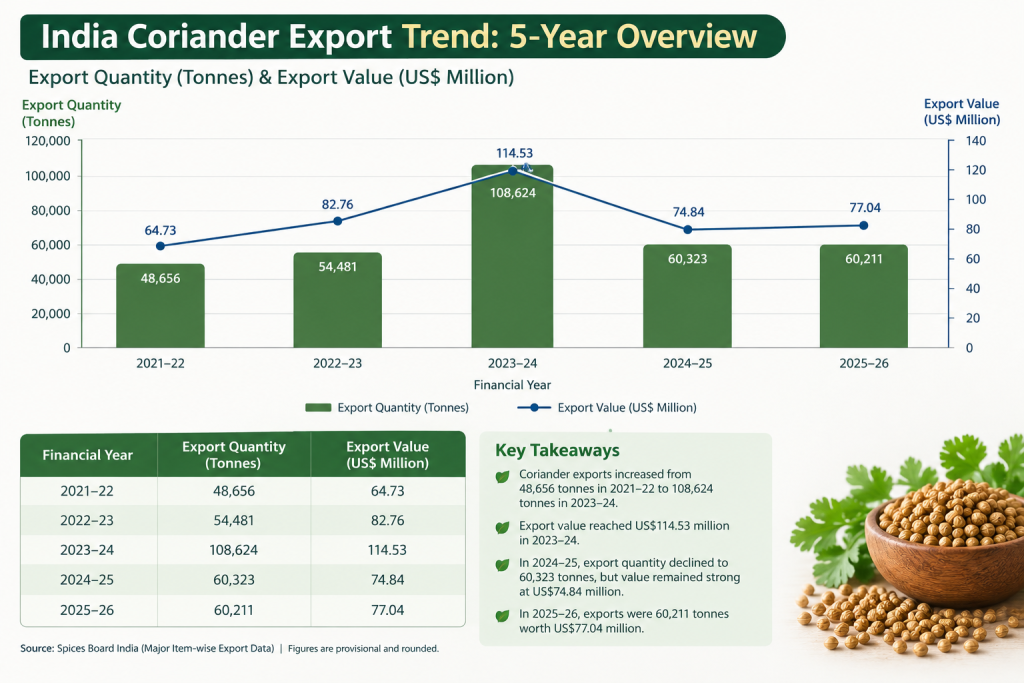
Coriander remains an established component of India’s spice export basket. According to the Spices Board of India, coriander accounted for around 2% of India’s spice export earnings in 2024–25, with export value of approximately US74.84million.In2025–26,corianderexportswereabout60,211tonnesvaluedatapproximatelyUS77.04 million.
India Coriander Export Trend
| Financial Year | Export Quantity | Export Value |
| 2021–22 | 48,656 tonnes | US$64.73 million |
| 2022–23 | 54,481 tonnes | US$82.76 million |
| 2023–24 | 108,624 tonnes | US$114.53 million |
| 2024–25 | 60,323 tonnes | US$74.84 million |
| 2025–26 | 60,211 tonnes | US$77.04 million |
The figures show that coriander exports can move considerably from one year to another. The strong volume recorded in 2023–24 was followed by lower volumes in 2024–25 and 2025–26. At the same time, export value has remained significant, showing why quality, market requirements and pricing conditions should all be considered before committing to a bulk purchase.
Major Markets for Indian Coriander
India supplies coriander to a diverse group of markets. In 2025–26, the leading destinations recorded in Spices Board data included Malaysia, the UAE, the USA, Saudi Arabia, the UK, Nepal, South Africa, Australia and Canada. Malaysia was the largest destination among the listed markets, with around 14,561 tonnes of coriander imported from India during the year.
Different markets can have different expectations regarding cleanliness, pesticide residues, packaging, documentation and product specifications. Therefore, a buyer should define the destination-market requirement before finalizing the specification.
7 Important Factors for Reliable Bulk Sourcing
1. Start With the Right Coriander Seed Specification
The first step in reliable sourcing is to define exactly what you need.
Coriander specifications can cover:
- Whole or processed coriander
- Seed size and appearance
- Colour
- Moisture level
- Foreign matter
- Admixture
- Damaged or discoloured seeds
- Purity
- Aroma
- Microbiological requirements
- Pesticide-residue limits
A buyer purchasing coriander for spice grinding may have different requirements from a food manufacturer purchasing whole seeds for retail packing.
Before requesting quotations, prepare a clear specification sheet. This allows suppliers to quote against the same quality requirements and makes supplier comparison much easier.
For Indian Coriander Export, specification clarity is particularly important because price differences can sometimes reflect differences in grade, cleaning, processing or testing rather than simply supplier margins.
2. Check the Origin and Procurement Region
The growing and trading origin of coriander can influence its characteristics and availability.
Indian coriander is sourced through established agricultural and commodity markets, with Rajasthan, Madhya Pradesh and Gujarat among the important producing and trading regions.
Buyers should ask where the coriander was sourced and whether the supplier can maintain the same specification across multiple lots.
Origin information becomes particularly useful when a buyer wants:
- Consistent colour
- Similar seed size
- Stable aroma
- Repeat shipments
- Traceability
- Seasonal procurement planning
A reliable supplier should be able to explain how raw material is procured and how different lots are consolidated before processing.
3. Purity and Foreign Matter Must Be Checked
For bulk coriander buyers, purity is one of the most important quality considerations.
Foreign matter can include unwanted plant material, stones, dust, stems or other materials mixed with the seeds. Excessive admixture can create processing problems and increase cleaning losses.
A professional sourcing process should therefore include:
- Visual inspection
- Cleaning
- Grading
- Removal of foreign matter
- Lot-wise quality checks
- Pre-shipment inspection where required
Buyers should agree on acceptable foreign-matter and admixture limits before placing an order rather than trying to resolve quality differences after arrival.
4. Moisture and Storage Conditions Matter
Moisture directly affects the storage stability of coriander.
If coriander is stored under unsuitable conditions, excessive moisture can contribute to mould development, deterioration, odour changes and loss of commercial quality.
Bulk buyers should therefore confirm:
- Moisture specification
- Warehouse conditions
- Storage duration
- Ventilation
- Protection from humidity
- Pest-control procedures
- Condition of the cargo before loading
The quality of a good coriander lot can still deteriorate if storage and transportation are poorly managed.
This is why reliable Indian Coriander Export requires attention beyond the farm or processing facility. The entire supply chain matters.
5. Cleaning, Grading and Sortex Processing
Modern processing can make a significant difference in the consistency of bulk coriander.
Professional cleaning and grading systems help remove unwanted material and improve uniformity. Sortex technology can also be used where required to identify and remove colour variations and unwanted particles.
A buyer should ask whether the supplier provides:
- Mechanical cleaning
- Grading
- Sortex processing
- Dust removal
- Metal detection where applicable
- Hygienic storage
- Batch-wise inspection
These processes are especially valuable for buyers supplying food manufacturers, spice processors and retail brands where consistency is important.
Mega Grain works with established processing and quality-control systems to support bulk agricultural commodity sourcing according to buyer requirements.
6. Test for Food Safety and Pesticide Residues
Food safety should never be treated as a secondary consideration in international spice sourcing.
Depending on the destination country and buyer specification, coriander may need testing for pesticide residues, microbiological parameters, contaminants and other food-safety requirements.
Importers should confirm the applicable standards before shipment and, where necessary, request laboratory analysis from an appropriate testing facility.
A practical quality-control process can include:
- Product sampling
- Laboratory testing
- Review of the analytical report
- Comparison against destination-market requirements
- Pre-shipment approval
- Loading supervision
The Spices Board notes that the quality of spices depends not only on raw material but also on processing, packing, storage and transportation. It also highlights the importance of pesticide-residue control for spices exported to international markets.
For buyers sourcing Indian Coriander Export for regulated markets, testing requirements should therefore be agreed upon before the cargo is dispatched.
7. Packaging, Documentation and Shipment Handling
Even high-quality coriander can face problems if packaging or cargo handling is inadequate.
Bulk coriander is commonly packed according to buyer and destination requirements, including PP bags, woven sacks or other suitable food-grade packaging. The exact bag size should be agreed before production or loading.
Buyers should confirm:
- Packaging material
- Bag weight
- Stitching and sealing
- Product labelling
- Container condition
- Fumigation requirements
- Shipping documents
- Certificate of Origin where required
- Phytosanitary documentation where applicable
- Commercial invoice and packing list
- Bill of Lading
- Inspection certificates where required
Shipment planning should also consider the destination port, transit time and weather conditions.
For long-distance shipments, proper container inspection and cargo protection can help reduce the risk of moisture exposure, contamination and handling damage.
Common Mistakes Bulk Coriander Buyers Should Avoid
International buyers can reduce sourcing problems by avoiding a few common mistakes:
Choosing only on price:
A lower quotation may reflect a lower grade, different cleaning standard or weaker testing process.
Using an unclear specification:
Terms such as “premium coriander” are not enough. Define measurable requirements.
Skipping pre-shipment inspection:
For large orders, checking the actual lot before loading can provide valuable protection.
Ignoring destination regulations:
The requirements of the importing country should be considered before the purchase contract is finalized.
Not checking packaging:
Packaging that works for short domestic movement may not always be suitable for international transit.
Buying without repeat-supply planning:
If the product is part of an ongoing manufacturing or retail program, discuss future availability and specification consistency from the beginning.
Why Choose Mega Grain for Indian Coriander Sourcing?
Mega Grain is an experienced Indian agricultural commodity trading and global trade facilitation group with more than 36 years of experience in pulses, cereals, grains, rice, spices, edible oils, dry fruits, sugar and other agricultural commodities.
For bulk coriander requirements, Mega Grain helps international buyers connect with suitable Indian supply sources and supports the sourcing process from quality specifications through documentation and shipment coordination.
Our approach focuses on:
- Verified commodity suppliers
- Buyer-specific specifications
- Quality and purity checks
- Cleaning and grading requirements
- Sortex processing where required
- Hygienic storage
- Proper packaging
- Documentation support
- Pre-shipment inspection
- Cargo and loading supervision
- Competitive sourcing
- Reliable shipment coordination
The objective is not simply to arrange one shipment. It is to create a sourcing process that buyers can use repeatedly with greater confidence.
Mega Grain Offices & Contact Details
Head Office:
402, Prabhat Kiran Building,
Rajendra Place, New Delhi – 110008, India
📞 +91-11 25719896 – 97
📞 +91-9555899006
📧 info@megagrain.com
🌐 www.megagrain.com
Contact Persons
- Neeraj Dhawan
- Radhika Dhawan
- Kritika Dhawan
Conclusion
Reliable bulk coriander sourcing starts with quality specifications and continues through procurement, cleaning, testing, packaging, documentation and shipment handling.
India remains an established source of coriander for international markets, and recent Spices Board data shows continued export activity across Asia, the Middle East, Europe, North America and other regions.
For buyers considering Indian Coriander Export, the most important approach is to look beyond the quoted price. A dependable supply partner should be able to provide consistent specifications, appropriate testing, professional processing, suitable packaging and proper documentation.
With the right quality controls and a reliable sourcing partner, bulk coriander purchases from India can become a more consistent and manageable part of an international spice supply chain.