
India is an important origin for fennel seeds used by spice processors, food manufacturers, distributors, wholesalers, retailers and international commodity buyers. For bulk buyers, sourcing fennel is not only about finding a competitive price. Consistent quality, cleanliness, moisture control, aroma, seed appearance, pesticide-residue compliance, packaging and reliable shipment execution all influence the success of an international purchase.
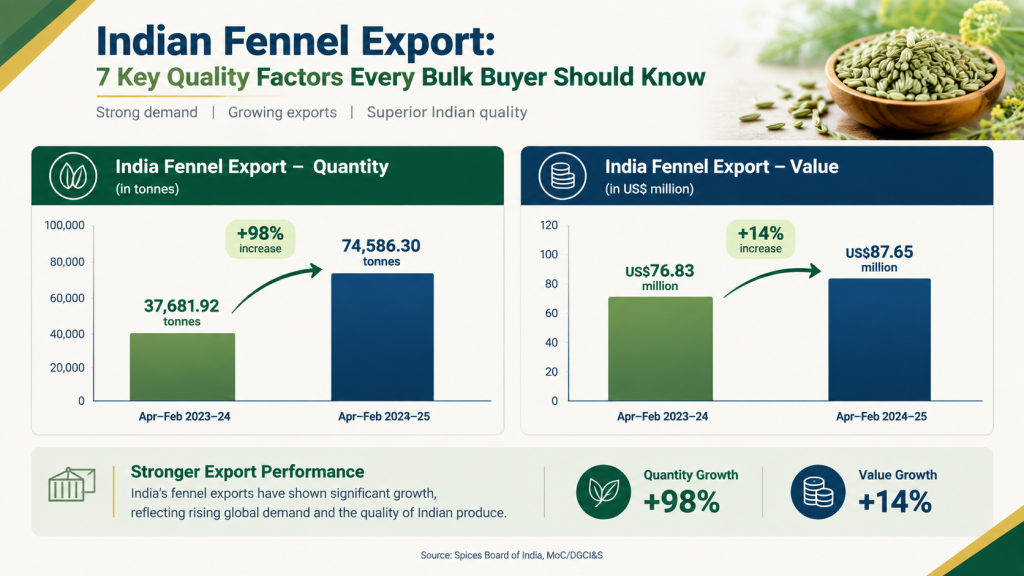
The Indian fennel export market has also shown significant movement in recent years. According to the Spices Board of India, fennel exports during April–February 2024–25 reached 74,586.30 tonnes, compared with 37,681.92 tonnes during April–February 2023–24, representing a 98% increase in quantity. Export value increased from US76.83milliontoUS87.65 million, a 14% increase.
For importers considering Indian fennel for bulk procurement, understanding the major quality parameters can help reduce rejection risks and maintain consistency across shipments.
Read More: Why Indian Spices are in High Demand Worldwide
Indian Fennel Export Market: Latest Data
The following data from the Spices Board of India provides a useful view of India’s fennel export performance.
| Period | Export Quantity | Export Value |
| Apr–Feb 2023–24 | 37,681.92 tonnes | US$76.83 million |
| Apr–Feb 2024–25 | 74,586.30 tonnes | US$87.65 million |
| Change | +98% | +14% |
Source: Spices Board of India; source data attributed to MoC/DGCI&S.
The increase in quantity shows a substantial expansion in fennel shipments during the compared periods, while the increase in value was more moderate. Buyers should therefore consider both market conditions and product specifications when evaluating quotations rather than comparing price alone.
Indian Fennel Export: Why Quality Matters for Bulk Buyers
Fennel seeds are sensitive to handling, storage and contamination. Their commercial value depends on factors such as seed appearance, cleanliness, aroma, moisture, maturity, foreign matter and compliance with the destination market’s food-safety requirements.
The Spices Board specifically notes that the quality of cumin and fennel depends on practices from pre-harvest operations through processing, packing, storage and transportation. It also advises that pesticides prohibited in importing countries should not be used and that importing countries check fennel for pesticide residues.
For an importer purchasing several tonnes or containers, even a small variation in quality can affect processing performance, customer acceptance and final product consistency.
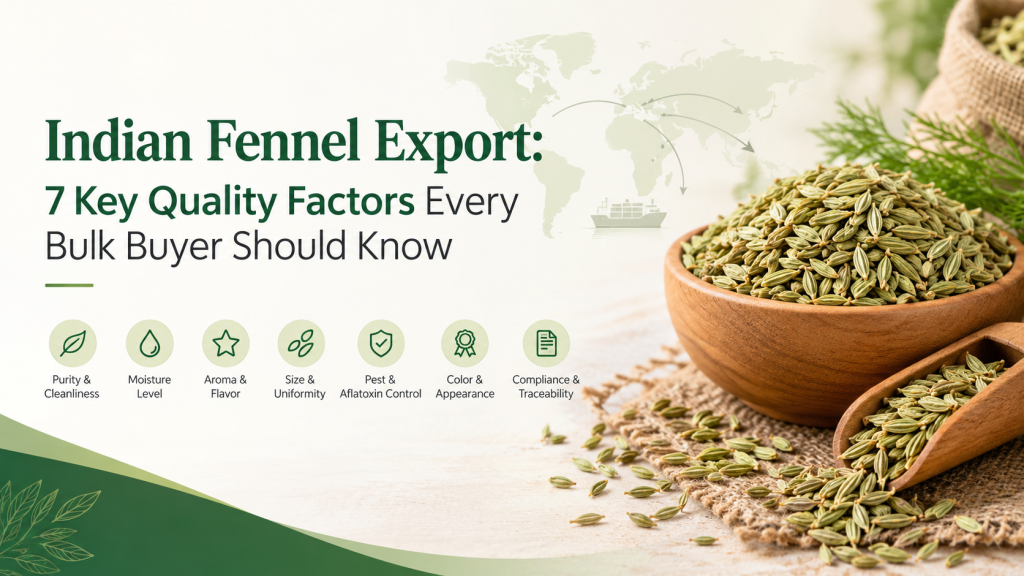
Here are seven important factors every bulk buyer should evaluate.
1. Fennel Seed Appearance and Uniformity
Appearance is one of the first quality indicators buyers evaluate when sourcing Indian fennel.
Good-quality fennel should have a clean and reasonably uniform appearance appropriate to the agreed commercial specification. Buyers commonly consider:
- Seed size and uniformity
- Colour
- Maturity
- Broken or damaged seeds
- Insect-damaged seeds
- Foreign material
- Other seed admixture
- Overall cleanliness
Uniformity becomes particularly important for food manufacturers and spice processors because inconsistent raw material can affect processing, blending and finished-product appearance.
Before placing a bulk order, buyers should clearly define the acceptable limits for defective seeds, foreign matter and other impurities in the purchase specification.
The Spices Board lists IS 3796:1993 as the Indian standard for whole fennel seeds.
2. Moisture Level and Proper Drying
Moisture is one of the most important factors in fennel quality.
Excess moisture can increase the risk of deterioration during storage and transportation. For exporters, proper drying and moisture control are therefore essential before packing the cargo.
The Spices Board’s quality guidance recommends that fennel be properly dried and protected from rain and moisture during post-harvest handling. It also recommends protecting stored material from dampness and preventing moisture ingress.
As a reference point, one Spices Board specification for fennel sachets lists moisture not more than 12%, although the exact contractual specification for a bulk export shipment should always be agreed according to the buyer’s requirements and destination regulations.
For bulk procurement, buyers should request:
- Moisture specification
- Pre-shipment test report
- Sampling procedure
- Storage conditions
- Container-loading controls
Moisture should not be treated as an afterthought because improper handling can affect the product after it has already passed initial inspection.
3. Aroma and Volatile Oil Content
Fennel is valued for its characteristic sweet, aromatic profile. Aroma is therefore an important commercial characteristic, particularly for buyers supplying spice blends, food products, herbal preparations and culinary applications.
Volatile oil content is one laboratory parameter that can help evaluate fennel quality. The Spices Board’s laboratory services include testing for volatile oil in spices, including fennel-related quality evaluation.
One published Spices Board specification for fennel lists volatile oil content on a dry basis at not less than 1.0% v/w for that particular product specification. Bulk buyers should not automatically apply this number to every shipment; instead, the required specification should be established in the purchase contract.
For buyers, the practical approach is to specify:
- Required aroma profile
- Applicable volatile-oil requirement
- Testing method
- Laboratory or inspection agency
- Acceptance criteria
This creates a measurable quality benchmark instead of relying only on visual inspection.
4. Foreign Matter, Defective Seeds and Cleanliness
Cleanliness is critical in bulk fennel sourcing.
Foreign matter may include unwanted plant material, stones, dust or other extraneous material. Defective or damaged seeds can also affect the commercial quality of the consignment.
A professional export supply chain should therefore include cleaning and sorting before final packing.
The Spices Board recommends careful cleaning and processing of cumin and fennel and emphasizes good practices throughout harvesting, processing, packing, storage and transportation.
Depending on the buyer’s requirements, processing may include:
- Cleaning
- Mechanical sorting
- Size or quality segregation
- Foreign-matter removal
- Final quality inspection
- Packing
- Pre-shipment verification
For large-volume orders, the buyer should agree on measurable limits rather than using only general descriptions such as “premium quality.”
5. Pesticide Residues and Food-Safety Compliance
Food-safety compliance is a major consideration in international fennel trade.
Different importing countries can have different requirements concerning pesticide residues, contaminants, microbiological parameters and documentation. Buyers should therefore communicate the destination-market requirements before the cargo is processed and shipped.
The Spices Board specifically warns that pesticides banned in importing countries should not be used on cumin and fennel and notes that importing countries test these products for pesticide residues.
Depending on the destination and buyer specification, laboratory evaluation can cover parameters such as:
- Pesticide residues
- Microbiological parameters
- Salmonella
- Yeast and mould
- Total plate count
- Heavy metals
- Volatile oil
- Other destination-specific requirements
The Spices Board laboratory lists testing capabilities for several pesticide-residue and microbiological parameters, among others.
For bulk buyers, the safest approach is to establish the required testing protocol before shipment rather than attempting to resolve compliance issues after the cargo reaches the destination.
6. Processing, Storage and Cargo Handling
Even good-quality fennel can deteriorate if it is poorly handled after processing.
Storage conditions, packaging, container cleanliness and cargo protection all contribute to maintaining quality during international transportation.
The Spices Board recommends keeping stored fennel protected from dampness, using appropriate stacking practices to reduce moisture ingress, preventing insects and rodents from accessing storage areas, and using authorized personnel for fumigation where required.
A professional bulk sourcing process should therefore consider:
- Hygienic storage
- Clean processing areas
- Moisture protection
- Pest-control procedures
- Appropriate fumigation where required
- Clean and suitable containers
- Loading supervision
- Proper cargo documentation
For international shipments, the product’s quality should remain consistent from the processing facility until the cargo reaches the buyer.
7. Inspection, Sampling and Export Documentation
The final quality factor is not only the product itself but also the verification and documentation supporting the shipment.
Before dispatch, bulk buyers can establish an agreed inspection procedure covering:
- Product specification
- Sampling method
- Quantity
- Moisture
- Foreign matter
- Defective seeds
- Pesticide residues where applicable
- Microbiological parameters where applicable
- Packaging
- Container condition
- Loading
- Documentation
Third-party inspection can also be arranged when required by the buyer, contract or destination market.
A clear specification sheet helps both parties understand what is being purchased. It should identify the agreed quality parameters, tolerance levels, packaging, quantity, inspection procedure and required documentation.
Indian Fennel Export Packaging for Bulk Buyers
Packaging should be selected according to the destination, handling conditions and buyer requirements.
Common bulk agricultural commodity packaging options can include:
- 25 kg bags
- 50 kg bags
- PP bags
- Customized buyer packaging
- Private-label packaging where applicable
The final packaging should protect the fennel from moisture, contamination and physical damage during storage and transportation.
For larger commercial shipments, container loading should be carefully supervised, with attention to bag condition, container cleanliness, cargo arrangement and documentation.
Indian Fennel Export Sourcing Process
A reliable sourcing process can make bulk procurement easier for international buyers.
A typical process can include:
Step 1: Buyer Requirement
The buyer provides the required quantity, destination, specification, packaging and delivery terms.
Step 2: Product Specification
The exporter and buyer agree on quality parameters such as moisture, foreign matter, defective seeds, size, aroma, pesticide-residue requirements and other applicable standards.
Step 3: Sampling and Quality Evaluation
Samples are evaluated against the agreed specification. Laboratory testing can be arranged where required.
Step 4: Commercial Confirmation
Price, quantity, packaging, payment terms, shipment schedule and other contractual conditions are finalized.
Step 5: Processing and Sorting
The fennel is cleaned, processed and sorted according to the agreed specification.
Step 6: Inspection and Loading
Pre-shipment inspection can be performed where required, followed by container loading and shipment documentation.
Step 7: Delivery
The cargo is dispatched according to the agreed Incoterms, shipping schedule and destination requirements.
Indian Fennel Export from India: What International Buyers Should Ask
Before confirming a bulk fennel order, buyers should ask suppliers for clear answers to the following:
- What is the origin of the fennel?
- What is the moisture level?
- What are the foreign-matter limits?
- What are the defective-seed limits?
- Is the product cleaned and sorted?
- What laboratory tests are available?
- Are pesticide-residue requirements covered?
- What packaging options are available?
- What is the minimum order quantity?
- Can third-party inspection be arranged?
- What documents will be provided?
- What is the expected shipment schedule?
- How is the cargo stored before loading?
These questions can help buyers compare suppliers on measurable commercial and quality parameters instead of comparing quotations alone.
Indian Fennel Export Market Trend
India’s fennel export figures show a significant increase in shipment quantity during the latest full April–February comparison published by the Spices Board.
During April–February 2023–24, India exported 37,681.92 tonnes of fennel valued at US$76.83 million. During April–February 2024–25, exports increased to 74,586.30 tonnes, while export value reached US$87.65 million. The Spices Board reported the year-on-year change at 98% in quantity and 14% in dollar value.
Fennel Export Data
| Period | Quantity (Tonnes) | Value (US$ Million) |
| Apr–Feb 2023–24 | 37,681.92 | 76.83 |
| Apr–Feb 2024–25 | 74,586.30 | 87.65 |
| Growth | 98% | 14% |
The figures are from the Spices Board of India and are sourced to MoC/DGCI&S.
*Graph data: Spices Board of India, MoC/DGCI&S. The first series represents tonnes; the second represents US$ million. *
Why Choose Mega Grain for Agricultural Commodity Sourcing?
Mega Grain is an India-based professional group engaged in the physical trading and facilitation of agricultural commodities, with a legacy of 36 years across pulses, cereals, grains, rice, edible oils, dry fruits, sugar and other agricultural commodities.
Mega Grain works as an indenter and global commodity trade facilitator, connecting buyers and suppliers while supporting international trade execution.
The company’s sourcing and trade-support approach includes screening and verification of agricultural commodity traders, with attention to:
- Consistent product quality
- Competitive pricing
- Documentation
- LC financing support
- Timely loading
- Delivery coordination
- International trade execution
Mega Grain has an international network covering markets and trade relationships across countries including the UAE, Saudi-linked regional markets, China, USA, Canada, Australia, Turkey, Egypt-linked markets, South Africa, Nigeria, Tanzania, Russia, Central Asia and other destinations.
For buyers sourcing Indian agricultural commodities, the objective is to create a structured connection between verified supply and international demand.
Mega Grain: Indian Agricultural Commodity Trade Facilitator
With offices and trade operations in India, Mega Grain supports international buyers looking to source agricultural commodities from India.
Our commodity categories include:
Rice | Pulses | Spices | Cereals | Edible Oils | Dry Fruits | Sugar
For fennel and other agricultural commodities, buyer requirements can be discussed around product specification, quantity, packaging, inspection, shipment and destination-market requirements.
Contact Mega Grain
Mega Grain
402, Prabhat Kiran Building
Rajendra Place
New Delhi – 110008
India
Phone: +91-11 25719896–97
Mobile: +91-9555899006
Email: info@megagrain.com
Website: www.megagrain.com
Contact Persons
Neeraj Dhawan
Radhika Dhawan
Kritika Dhawan
Conclusion
Indian fennel offers international buyers an established sourcing opportunity, but successful bulk procurement requires more than comparing prices. Buyers should evaluate seed appearance, moisture, aroma, volatile oil content, cleanliness, pesticide-residue compliance, processing, storage, packaging, inspection and documentation before confirming a shipment.
The latest Spices Board data shows that India’s fennel exports increased substantially in quantity during April–February 2024–25 compared with the same period of 2023–24, reaching 74,586.30 tonnes compared with 37,681.92 tonnes previously. Export value increased from US76.83milliontoUS87.65 million.
For international buyers, the key is to establish a clear product specification before purchase and maintain that specification throughout sourcing, processing, inspection, packing and shipment.
Mega Grain connects international commodity buyers with Indian agricultural supply and supports structured trade execution across multiple commodity categories.
Looking to source Indian fennel or other agricultural commodities in bulk? Contact Mega Grain to discuss your product specifications, quantity, packaging and destination requirements.