
Cumin is one of India’s most important seed spices and has a strong position in international food and spice markets. For importers, however, successful bulk sourcing is about much more than finding the right price. Quality, seed purity, moisture, cleaning, pesticide-residue compliance, packaging, documentation, and shipment planning all need to be considered before confirming a large order.
India has established cumin-growing and trading networks, particularly across Gujarat and Rajasthan. These supply regions support domestic and international demand and provide buyers with access to commercially suitable cumin seeds for food processing, spice blending, seasoning, grinding, and distribution.
The recent Indian Cumin Export figures also show how significantly the market can change between financial years. In 2024–25, India exported 229,881.07 tonnes of cumin worth US$732.35 million, compared with 165,269.45 tonnes worth US$700.37 million in 2023–24.
For bulk buyers, understanding these market movements alongside product quality and compliance requirements can make sourcing more predictable.
Read More: Why Indian Spices are in High Demand Worldwide
Indian Cumin Export Trend: 5-Year Market Overview
Looking at several years of export data gives international buyers a better understanding of the scale and movement of India’s cumin trade.
| Financial Year | Export Quantity | Export Value (US$ million) |
| 2020–21 | 298,423 tonnes | 573.60 |
| 2021–22 | 216,971 tonnes | 448.60 |
| 2022–23 | 186,509 tonnes | 521.89 |
| 2023–24 | 165,269 tonnes | 700.37 |
| 2024–25 | 229,881 tonnes | 732.35 |
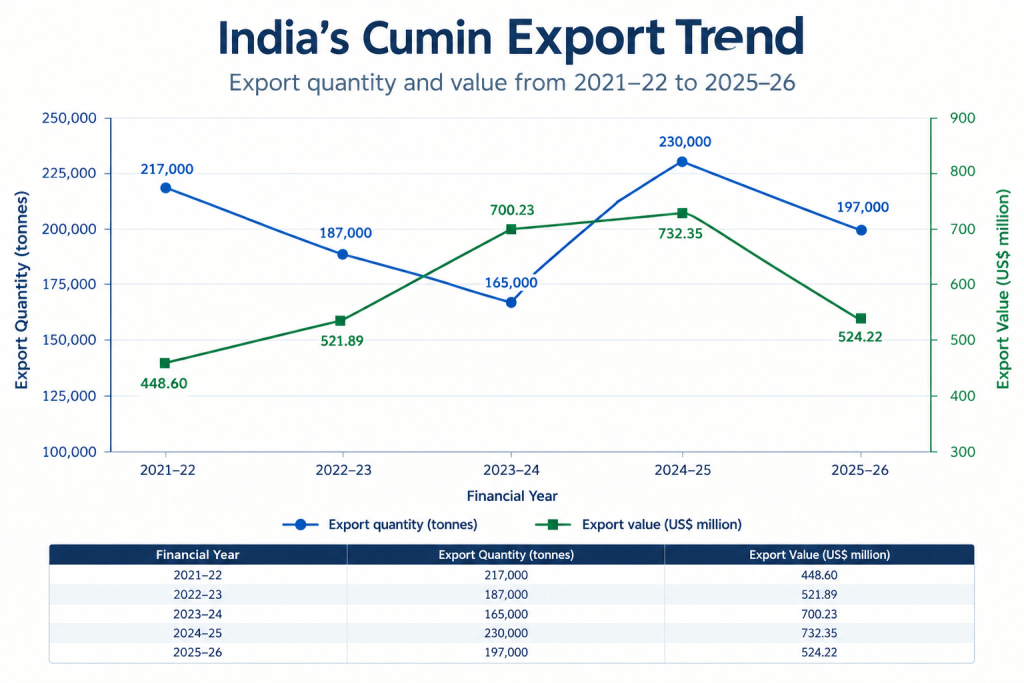
The data shows that cumin export volume declined considerably between 2020–21 and 2023–24. However, export value did not move in exactly the same direction. By 2023–24, export value had reached about US$700 million despite the lower volume.
The following year brought a strong recovery in quantity. India’s cumin exports increased by approximately 39% in volume in 2024–25, while export value increased by about 5%.
This difference between volume and value is important for importers. Cumin prices can be influenced by crop conditions, domestic availability, international demand, quality, and market requirements. Therefore, buyers should evaluate both market conditions and product specifications when planning bulk procurement.
India Cumin Market in 2025–26
The importance of cumin has continued into the latest spice-export data.
According to Spices Board India’s review for 2025–26, cumin represented 12% of India’s total spice export basket by value, making it one of the country’s leading spice export categories. India exported 17.34 lakh tonnes of spices and spice products during 2025–26, valued at US$4.43 billion.
For buyers, this indicates that cumin remains an important part of India’s broader international spice trade rather than being a small or occasional export commodity.
Market-Wise Overview for Indian Cumin Buyers
International buyers should also understand the major markets connected with India’s spice trade.
Spices Board India lists the USA, China, UAE, Bangladesh and Saudi Arabia among India’s major overall spice export destinations. Together with other markets including the UK, Thailand, Malaysia, Indonesia, Sri Lanka, Germany, the Netherlands, Canada, Nepal and Australia, these destinations account for more than 85% of India’s total spice export earnings.
For cumin buyers, the exact specification and compliance requirements can vary by destination.
USA
The USA is one of India’s largest overall spice markets. Buyers sourcing cumin for food manufacturing, seasoning, distribution, or retail applications should confirm their requirements for cleanliness, pesticide residues, microbiological quality, packaging, and documentation before placing a bulk order.
China
China is another major destination in India’s overall spice trade. Importers should establish the required product specification, packaging, documentation, and any applicable market-access or registration requirements before shipment.
UAE
The UAE is an important regional trading and distribution hub. Buyers may require commercially competitive cumin with consistent quality and packaging suitable for local distribution or onward trade.
Bangladesh
Bangladesh is also a significant destination for Indian spices. Bulk cumin buyers should agree on specifications, packing, quantity, documentation, and delivery terms before confirming the shipment.
Saudi Arabia and Middle Eastern Markets
Saudi Arabia is among India’s major overall spice export destinations. Importers should check applicable food-safety, labelling, packaging, inspection, and documentation requirements according to their specific business needs.
European Union
The European market requires particularly careful attention to pesticide-residue compliance for Indian cumin.
An EU regulation published in January 2026 lists cumin seeds from India under increased official controls for pesticide residues, with a 30% frequency of identity and physical checks.
Spices Board India has also issued a monitoring mechanism for pesticide-residue testing in cumin destined for the EU. Its 2025 circular states that consignments subject to the notified requirements must meet EU standards for pesticide residues and relevant testing requirements before export clearance.
This makes early testing and compliance planning especially important for buyers supplying European customers.
7 Essential Factors for Successful Bulk Sourcing
1. Define the Right Cumin Specification
A reliable bulk order starts with a detailed product specification.
Instead of requesting simply “good quality cumin,” importers should establish measurable requirements before asking for quotations.
Important specifications can include:
- Whole cumin seeds
- Seed size and uniformity
- Moisture
- Foreign matter
- Admixture
- Damaged or broken seeds
- Immature seeds
- Colour and appearance
- Aroma and natural flavour
- Purity
- Microbiological parameters
- Pesticide-residue limits
- Destination-specific requirements
Different buyers can have very different requirements. A spice blender may focus on aroma and purity, while a food manufacturer may require stricter testing and microbiological parameters.
A written specification makes the sourcing process much clearer for both parties.
2. Check the Cumin Origin and Supply Region
Origin is another useful consideration when sourcing cumin from India.
Gujarat and Rajasthan are important cumin-producing and trading regions. The supply chain around these areas gives buyers access to established agricultural and commercial networks.
However, origin should not be considered a substitute for quality inspection.
Before confirming a shipment, buyers should evaluate the actual lot for:
- Seed appearance
- Uniformity
- Cleanliness
- Aroma
- Moisture
- Foreign matter
- Overall purity
A representative sample can help buyers understand whether the offered product matches their specification before they commit to the complete quantity.
3. Verify Cleaning, Grading and Sortex Processing
Cumin is an agricultural product, so proper post-harvest handling is essential.
Cleaning and processing can remove unwanted materials and improve lot consistency.
Depending on the facility and buyer requirements, processing can include:
- Pre-cleaning
- Mechanical cleaning
- Grading
- Size separation
- Foreign-matter removal
- Sortex processing where applicable
- Hygienic handling
- Controlled storage
The objective is not just visual improvement. Consistent processing can make the cumin more suitable for industrial food applications and further processing.
Spices Board India also emphasizes that spice quality depends on processing, packing, storage, and transportation practices in addition to raw-material quality.
4. Prioritize Testing and Pesticide-Residue Compliance
Testing is one of the most important parts of modern spice sourcing.
Importers should confirm the testing requirements for their destination before the cargo is prepared.
Depending on the market and buyer specification, testing can cover:
- Pesticide residues
- Moisture
- Microbiological parameters
- Foreign matter
- Contaminants
- Other destination-specific food-safety requirements
The EU requirements make this especially important for cumin shipped to European markets.
Spices Board India also provides sampling and testing-related services for exporters.
For bulk buyers, discussing testing during the sample-approval stage can help avoid delays later.
5. Select Suitable Bulk Packaging
Packaging protects cumin during storage, handling, and international transportation.
Commercial buyers may request:
- 25 kg bags
- 50 kg bags
- PP bags
- Food-grade inner liners
- Customized or private-label packaging
The final packaging should be decided according to the buyer’s market, warehouse, production process, and destination requirements.
Properly sealed bags can help protect the product from moisture and contamination. The container should also be clean, dry, and suitable for food cargo before loading.
6. Confirm Documentation and Export Compliance
Documentation is another essential part of bulk sourcing.
Depending on the transaction and destination, the shipment may require:
- Commercial invoice
- Packing list
- Certificate of origin
- Shipping documents
- Laboratory reports
- Inspection documents where required
- Phytosanitary documentation where applicable
- Fumigation-related documents where applicable
- Destination-specific certificates
For spice exporters in India, the Certificate of Registration as Exporter of Spices (CRES) is mandatory in addition to the IEC.
Buyers should discuss documentation requirements early, especially when supplying regulated food markets.
7. Plan Shipment and Cargo Handling Properly
Bulk sourcing continues beyond product selection.
Before dispatch, the buyer and supplier should confirm:
- Final quantity
- Packing format
- Container requirements
- Port of loading
- Inspection requirements
- Testing requirements
- Loading schedule
- Shipping documents
- Delivery terms
- Destination port
Good communication between the supplier, buyer, freight forwarder, and inspection team can reduce avoidable delays.
For food-grade cumin, cargo handling also deserves attention. Containers should be clean and dry, while the packed product should be protected against moisture and contamination throughout the journey.
Common Mistakes Bulk Cumin Buyers Should Avoid
Buying Only on Price
The cheapest quotation may not offer the best commercial value if quality, testing, or documentation problems arise later.
Skipping Sample Approval
A sample gives buyers an opportunity to evaluate the product before committing to a full shipment.
Using Vague Quality Terms
“Premium cumin” is not a measurable specification. Buyers should define the actual quality parameters they require.
Ignoring Destination Requirements
A specification accepted in one country may not automatically meet another market’s requirements.
Leaving Testing Until Shipment Time
Testing requirements should be discussed before production and loading, particularly for regulated markets.
Treating Every Crop Year the Same
Cumin is an agricultural commodity. Crop conditions, availability, prices, and export volumes can change between seasons.
Why Choose Mega Grain for Indian Cumin Sourcing?
Mega Grain is an India-based agricultural commodity trading and global trade facilitation group with more than 36 years of industry experience.
For international buyers, Mega Grain can coordinate sourcing around agreed specifications, quality requirements, packaging, documentation, inspection, and shipment planning.
The process begins by understanding the buyer’s requirement and then coordinating the product and logistics around those specifications.
For bulk cumin buyers, this can provide a more organized sourcing process from sample approval through packing and dispatch.
Mega Grain Offices & Contact Details
Head Office:
402, Prabhat Kiran Building,
Rajendra Place, New Delhi – 110008, India
📞 +91-11 25719896 – 97
📞 +91-9555899006
📧 info@megagrain.com
🌐 www.megagrain.com
Contact Persons
- Neeraj Dhawan
- Radhika Dhawan
- Kritika Dhawan
Conclusion
Successful bulk sourcing requires more than finding a supplier and negotiating a price. Importers need clear specifications, reliable cleaning and processing, proper testing, destination-specific compliance, suitable packaging, accurate documentation, and well-planned logistics.
The latest Indian Cumin Export data shows that India’s cumin trade can change significantly from one financial year to another. Export quantity recovered strongly in 2024–25, while cumin remained one of India’s major spice export categories in 2025–26.
For international buyers, combining market awareness with quality verification and clear commercial specifications can make Indian cumin sourcing more consistent and commercially manageable.