
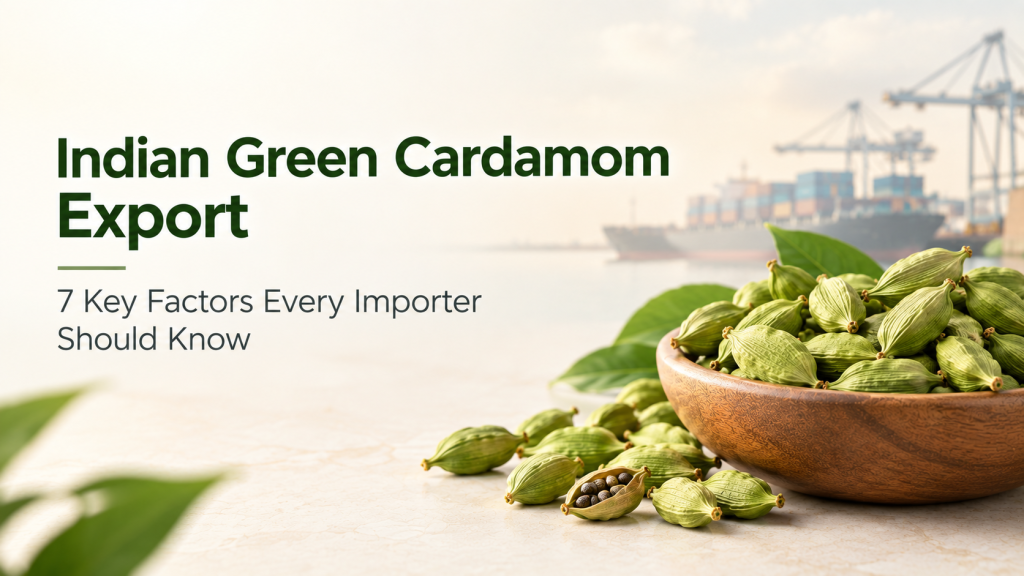
For international buyers, sourcing cardamom is not simply about finding a supplier and agreeing on a price. The grade, pod appearance, aroma, moisture level, cleaning process, packaging, testing requirements, documentation, and shipment planning can all affect the final buying decision.
India is an important origin for green cardamom, and international buyers often look for consistent quality and reliable commercial handling when placing bulk orders. Understanding the important stages involved in Indian Green Cardamom Export can help importers make better purchasing decisions and avoid quality or shipment-related issues.
Read More: Indian Cardamom Supplier: Complete Guide to Grades, Quality & Bulk Sourcing
Why Indian Green Cardamom Is Important for International Buyers
Green cardamom is valued for its distinctive aroma, warm flavour, and versatility. It is used in spice blends, beverages, confectionery, bakery products, traditional foods, and food-processing applications.
For commercial buyers, however, aroma alone is not enough. Buyers usually need clearly defined specifications covering size, colour, moisture, cleanliness, packaging, and other destination-specific requirements.
This makes proper sourcing and quality coordination important when purchasing cardamom in bulk from India.
1. Choose the Right Cardamom Grade
Cardamom pods are commonly purchased according to size and overall appearance. For commercial sourcing, buyers may request different size specifications depending on their application and target market.
Mega Grain works with commercially relevant green cardamom specifications including:
7 mm Cardamom
This grade can be suitable for buyers looking for a relatively smaller commercial pod size while maintaining acceptable appearance and quality.
7–8 mm Cardamom
This range offers a balance between pod size and commercial usability and can be suitable for various food and spice applications.
8 mm Cardamom
Larger pods can be preferred where visual appearance, pod size, and premium positioning are important purchasing considerations.
Before confirming a bulk order, importers should clearly specify the required size range, colour, appearance, moisture level, and acceptable tolerance.
2. Check Quality and Physical Specifications
One of the most important parts of Indian Green Cardamom Export is establishing clear quality specifications before shipment.
Depending on the destination and buyer requirements, important parameters may include:
- Pod size and uniformity
- Green colour and appearance
- Moisture level
- Foreign matter
- Damaged or broken pods
- Empty or immature pods
- Aroma and flavour
- Cleanliness
- Admixture
- Microbiological parameters where applicable
- Pesticide residue requirements
- Other destination-specific food-safety parameters
Specifications should be agreed before the order is finalized. This reduces the possibility of disagreements between buyer and supplier after production or shipment.
3. Cleaning, Sortex and Hygienic Processing Matter
Post-harvest handling can have a major impact on the commercial quality of cardamom.
Cardamom intended for international markets may undergo cleaning and sorting processes to remove unwanted material and improve lot consistency. Modern sorting technology, including Sortex systems where appropriate, can help separate material according to visual characteristics.
Hygienic handling is equally important. Cardamom should be stored and handled in conditions that help protect it from moisture, contamination, pests, and unwanted odours.
A professional sourcing process should therefore consider more than the appearance of the product at the time of purchase. The buyer should also understand how the product is cleaned, sorted, stored, and prepared before dispatch.
4. Approve Samples and Confirm Testing Requirements
Sample approval is one of the simplest ways for an importer to reduce uncertainty before placing a large order.
A representative sample allows buyers to review:
- Pod size
- Colour
- Aroma
- Cleanliness
- General appearance
- Moisture
- Physical defects
- Other agreed specifications
For international shipments, testing requirements can vary according to the destination country, product specification, and applicable regulations.
Therefore, buyers should confirm in advance whether third-party inspection, laboratory testing, pesticide-residue testing, microbiological analysis, or other certificates are required.
The sample approved by the buyer should also be used as a reference when preparing the commercial lot.
5. Select Packaging According to the Market
Packaging plays an important role in protecting cardamom during storage and transportation.
The appropriate packing format depends on the buyer’s market, distribution model, storage conditions, and retail or food-processing requirements.
Commercial buyers may request different packing sizes, including:
- 1 kg
- 2 kg
- 5 kg
- 10 kg
- 25 kg
- 50 kg
Master packing can also be arranged according to the buyer’s requirements.
Packaging should protect the pods from moisture, contamination, physical damage, and exposure to unsuitable storage conditions.
For Indian Green Cardamom Export, packaging specifications should ideally be finalized before production and shipment planning rather than at the last stage.
6. Understand Export Documentation and Compliance
International spice shipments require proper documentation and compliance with applicable export and destination-market requirements.
Depending on the shipment and destination, buyers and suppliers may need to coordinate documents such as:
- Commercial invoice
- Packing list
- Certificate of origin
- Shipping documents
- Phytosanitary documentation where applicable
- Inspection or laboratory reports where required
- Fumigation-related documentation where applicable
- Other certificates requested by the importing country
Spices Board requirements should also be considered when applicable. Exporters of spices from India may need the relevant registration and compliance documentation for their business and shipment.
Importers should communicate destination-country requirements before confirming the order. This helps avoid documentation delays after the cargo has already been prepared.
7. Plan Shipment and Cargo Handling Carefully
Good-quality cardamom can still face problems if it is not handled correctly during transportation.
Before dispatch, buyers and suppliers should discuss:
- Port of loading
- Container requirements
- Shipment schedule
- Packing configuration
- Cargo protection
- Storage conditions
- Required shipping documents
- Inspection requirements
- Transit expectations
Mega Grain can coordinate commercial shipment requirements according to the buyer’s specifications and destination.
Proper cargo handling helps maintain the agreed product condition from the point of loading through international transportation.
Common Mistakes International Cardamom Importers Should Avoid
International buyers can reduce sourcing problems by avoiding several common mistakes.
Buying Only on Price
The lowest quotation may not always represent the best commercial value. Grade, quality, testing, packaging, and shipment reliability should also be considered.
Not Defining Specifications Clearly
Terms such as “premium cardamom” can mean different things to different buyers. Size, colour, moisture, defects, packaging, and testing requirements should be clearly stated.
Skipping Sample Approval
A sample provides an opportunity to confirm whether the proposed product matches the buyer’s expectations before a bulk order is finalized.
Ignoring Destination Requirements
Import regulations and testing requirements can differ between markets. Buyers should confirm these requirements before shipment preparation.
Finalizing Packaging Too Late
Packaging affects the overall shipment configuration and should be discussed during order planning.
Why Choose Mega Grain for Indian Green Cardamom Export?
Mega Grain is an India-based agricultural commodity trading and global trade facilitation group with more than 36 years of industry experience.
For international cardamom buyers, Mega Grain focuses on understanding product requirements before coordinating the commercial order. This includes specifications, quality expectations, packaging, documentation, inspection requirements, and shipment coordination.
Mega Grain can support sourcing of green cardamom in commercially relevant grades such as 7 mm, 7–8 mm, and 8 mm, depending on availability and buyer requirements.
The sourcing process can include quality checks, hygienic handling, appropriate sorting and cleaning, suitable storage, packaging coordination, and cargo preparation.
For long-term buyers, consistency is especially important. A reliable supply relationship allows specifications and handling requirements to be understood clearly across repeat orders.
Mega Grain Offices & Contact Details
Head Office:
402, Prabhat Kiran Building,
Rajendra Place, New Delhi – 110008, India
📞 +91-11 25719896 – 97
📞 +91-9555899006
📧 info@megagrain.com
🌐 www.megagrain.com
Contact Persons
- Neeraj Dhawan
- Radhika Dhawan
- Kritika Dhawan
Conclusion
Successful Indian Green Cardamom Export depends on much more than product availability. Importers should evaluate the right grade, physical quality, cleaning and sorting process, sample approval, testing requirements, packaging, documentation, and cargo handling before confirming a bulk order.
A clearly defined specification and reliable communication between buyer and supplier can reduce quality issues and make international sourcing more predictable.
For international buyers looking for Indian green cardamom, working with an experienced sourcing partner can make the process easier from product selection through shipment coordination.