
Indian Basmati rice is recognised in international markets for its aroma, slender grains and distinctive cooking qualities. Among the varieties available to importers, 1509 Basmati Rice is an important option for buyers looking for long-grain rice for retail, wholesale, restaurant and food-service markets.
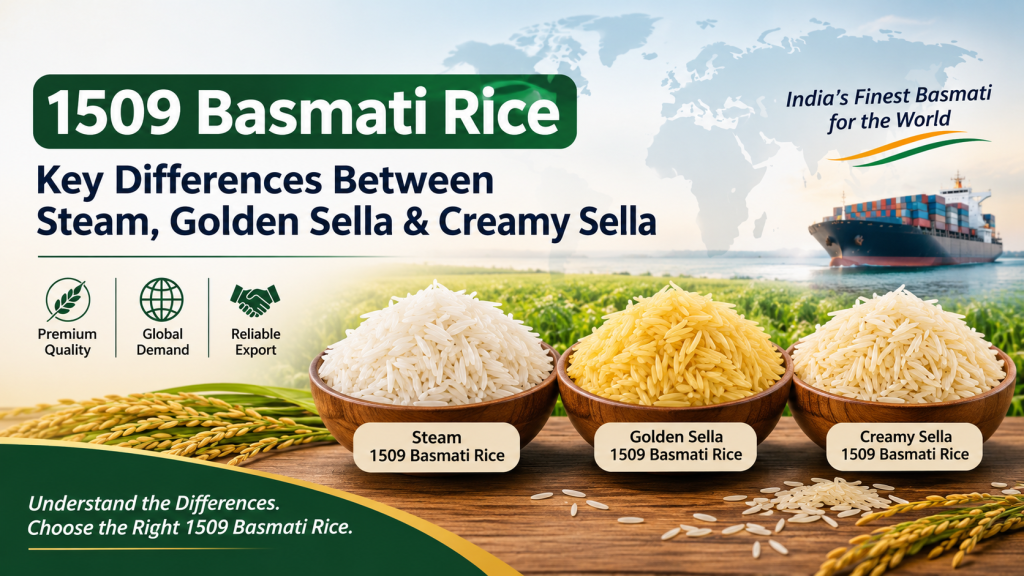
It is available in three commonly traded processing forms: Steam, Golden Sella and Creamy Sella. Although these forms come from the same variety, their processing methods influence grain colour, texture and cooking behaviour.
For importers, understanding these differences is essential when selecting the right product for their customers. This guide covers the three forms of 1509 Basmati Rice, quality specifications, processing, packaging, export documentation and India’s recent Basmati export trend.
Read More: Indian Rice Varieties for Export
1. Understanding the 1509 Variety
1509 is a recognised Basmati variety grown in India and traded in domestic and international markets. Buyers often consider it when comparing different long-grain Basmati options for commercial use.
The final product quality depends on several factors, including paddy condition, milling, processing, sorting, storage and ageing. Buyers should evaluate the actual sample instead of relying only on the variety name. When purchasing 1509 Basmati Rice, importers should also consider the intended market, cooking requirements and customer preferences.
When sourcing this variety, importers should pay attention to:
- Average grain length and uniformity
- Broken grain percentage
- Moisture content
- Natural aroma
- Grain colour and appearance
- Foreign matter and admixture
- Cooking performance and grain elongation
These parameters should be agreed upon before the order is confirmed. A written specification sheet helps both buyer and supplier maintain consistent expectations.
2. Steam, Golden Sella and Creamy Sella: Processing Differences
The three forms are differentiated mainly by their processing methods. Understanding the process helps buyers select the appropriate appearance and cooking characteristics for their target market. The processing form selected for 1509 Basmati Rice can influence its appearance, texture and suitability for different food applications.
Steam Basmati Rice
Steam processing involves treating paddy with steam before milling. It influences the grain structure while generally retaining a natural white or off-white appearance.
Key characteristics:
- Natural white or off-white colour
- Long, slender grain appearance
- Suitable for biryani, pulao and everyday rice dishes
- Preferred by buyers looking for a lighter-coloured product
- Requires controlled milling and sorting for consistent quality
Steam rice is commonly considered by distributors, retailers and food-service businesses that prefer a relatively natural-looking grain. Buyers evaluating Steam 1509 Basmati Rice should check grain uniformity, aroma and cooking performance through an approved sample.
Golden Sella Basmati Rice
Golden Sella is produced through parboiling. Paddy is soaked and treated with heat before drying and milling. This process gives the finished rice its characteristic golden or yellowish appearance.
Key characteristics:
- Golden or yellowish grain colour
- Generally firm grain structure
- Suitable for biryani and large-scale food preparation
- Often preferred in markets where golden-coloured parboiled rice is popular
- Requires careful control of parboiling and drying conditions
Buyers should assess colour uniformity, grain strength and cooking performance when evaluating Golden Sella samples. Golden Sella 1509 Basmati Rice can be considered by importers whose customers prefer the appearance and cooking characteristics of parboiled rice.
Creamy Sella Basmati Rice
Creamy Sella is also produced through parboiling but generally has a lighter cream or pale ivory appearance compared with Golden Sella.
Key characteristics:
- Cream or pale ivory colour
- Parboiled processing
- Generally firm grain structure
- Suitable for biryani, catering and bulk food-service applications
- An alternative for buyers who prefer a lighter parboiled appearance
The exact colour and texture can vary with paddy quality and processing conditions. Importers should approve a sample before confirming the final order. Creamy Sella 1509 Basmati Rice is an option for buyers seeking a lighter-coloured parboiled product.
3. Steam vs Golden Sella vs Creamy Sella
The differences between the three forms can help importers match their product selection to local customer preferences. Comparing these forms of 1509 Basmati Rice side by side can make it easier to identify the right processing type for a particular market.
| Parameter | Steam | Golden Sella | Creamy Sella |
| Processing | Steam-treated | Parboiled | Parboiled |
| Appearance | White/off-white | Golden/yellowish | Cream/pale ivory |
| Grain structure | Depends on batch and milling | Generally firm | Generally firm |
| Common applications | Biryani, pulao, retail | Biryani, catering | Biryani, catering |
| Buyer preference | Natural lighter appearance | Golden colour | Lighter parboiled appearance |
The best choice depends on the buyer’s target market, cooking practices, customer expectations and required specifications. Comparing samples side by side is a practical way to evaluate the differences.
4. Important Quality Specifications for Bulk Buyers
Before purchasing 1509 Basmati Rice, buyers should establish clear quality parameters with their supplier. Specifications can vary by grade, destination and commercial agreement.
Grain length: Confirm the required average grain length and whether measurements refer to raw or cooked rice. The approved sample should represent the expected shipment quality.
Broken percentage: Define the maximum permitted broken percentage. Retail and institutional buyers may have different requirements.
Moisture content: Moisture should remain within the agreed commercial and destination-market limits. Proper drying and storage help protect product quality.
Foreign matter: Dust, stones, husk and other unwanted materials should be controlled through cleaning and sorting.
Damaged grains: Agree on acceptable limits for damaged, discoloured and immature grains.
Admixture: Specify the acceptable purity level and admixture limits in the contract.
Aroma and cooking quality: Evaluate natural aroma, texture, elongation and grain separation through a cooking test.
There is no universal specification for every shipment. The final quality sheet should be agreed upon by both parties before processing and dispatch. Buyers should use these checks when comparing different suppliers of 1509 Basmati Rice.
5. Processing, Sortex and Quality Control
Consistent export quality requires attention at every stage, from raw paddy selection to finished-product packing. For 1509 Basmati Rice, a structured processing and quality-control system helps suppliers meet the specifications agreed with international buyers.
A structured processing and quality-control system should include:
- Raw material inspection: Check incoming paddy for quality and suitability.
- Cleaning: Remove dust, stones and unwanted materials.
- Processing: Apply the required steam or parboiling method.
- Milling and polishing: Process the rice according to the agreed grade.
- Sortex sorting: Use optical sorting to identify and remove discoloured or defective grains.
- Quality inspection: Check the finished product against the buyer’s approved specifications.
- Hygienic storage: Maintain suitable storage conditions before dispatch.
- Packing supervision: Verify bag weight, stitching and packaging condition.
Mega Grain places importance on supplier coordination, quality verification, Sortex processing requirements, hygienic storage and cargo maintenance when coordinating commodity shipments.
6. Packaging Options for International Buyers
Packaging plays an important role in protecting rice during handling, storage and international transportation. Buyers sourcing 1509 Basmati Rice should select packaging according to order volume, distribution channels and destination-market requirements.
Common packaging options include:
- 5 kg and 10 kg consumer packs
- 20 kg and 25 kg bags
- 50 kg PP bags
- Buyer-specific private-label packaging, subject to agreement
Buyers should confirm the bag material, net weight, stitching, printing, labelling and packaging design before production.
For container shipments, the loading plan should consider bag dimensions, stacking arrangement, cargo protection and container capacity. Packaging and labelling must also comply with the importing country’s applicable food regulations.
7. Export Documentation and Shipment Planning
International rice shipments require accurate documentation and coordination between the supplier, buyer, freight forwarder and customs broker. Exporters arranging shipments of 1509 Basmati Rice should confirm the documentation requirements for the destination before dispatch.
Depending on the shipment and destination, documents may include:
- Commercial Invoice
- Packing List
- Shipping Bill
- Bill of Lading
- Certificate of Origin, where required
- Phytosanitary or inspection documents, where applicable
- Fumigation certificate, where required
- Quality or laboratory certificate, as agreed
Indian rice exporters must follow applicable APEDA registration and export requirements. Import rules vary by country, so buyers should verify current destination requirements before shipment.
Major Indian ports used for rice shipments include Mundra, Kandla and Nhava Sheva. The final port depends on the supplier’s location, shipping line, freight arrangement and destination.
Before dispatch, both parties should confirm Incoterms, payment terms, shipment schedule, inspection requirements, loading arrangements and documentation responsibilities.
8. What Buyers Should Check Before Placing an Order
A clear purchasing process helps reduce quality disputes and shipment delays. Before confirming a bulk order of 1509 Basmati Rice, international buyers should:
- Confirm the variety and processing form.
- Request a recent product sample.
- Approve grain length and broken percentage.
- Confirm moisture and foreign matter limits.
- Agree on colour, aroma and cooking expectations.
- Finalise packaging and labelling.
- Confirm quantity and shipment schedule.
- Decide whether pre-shipment or third-party inspection is needed.
- Verify destination-country import requirements.
- Agree on payment terms and shipping responsibilities.
For repeat orders, maintaining an approved sample and written specification sheet can help buyers compare new shipments with previous purchases.
9. Why Choose Mega Grain for Rice Requirements?
Mega Grain is an India-based agricultural commodity trading and global trade facilitation group with more than 36 years of experience in physical commodity trading.
The company works across rice, pulses, spices, cereals, edible oils, dry fruits and other agricultural commodities. Its focus is on connecting international buyers with suitable supply sources and coordinating important stages of commodity trade.
For rice buyers, Mega Grain supports:
- Product and specification coordination
- Supplier and quality verification
- Processing and sorting requirements
- Packaging discussions based on buyer needs
- Export documentation coordination
- Shipment planning and loading follow-up
- Communication throughout the trade process
Importers interested in 1509 Basmati Rice can discuss the required processing form, grade, quantity, packaging and destination with the Mega Grain team. Product availability and final specifications should be confirmed for each order.
10. Three-Year Indian Basmati Rice Export Trend
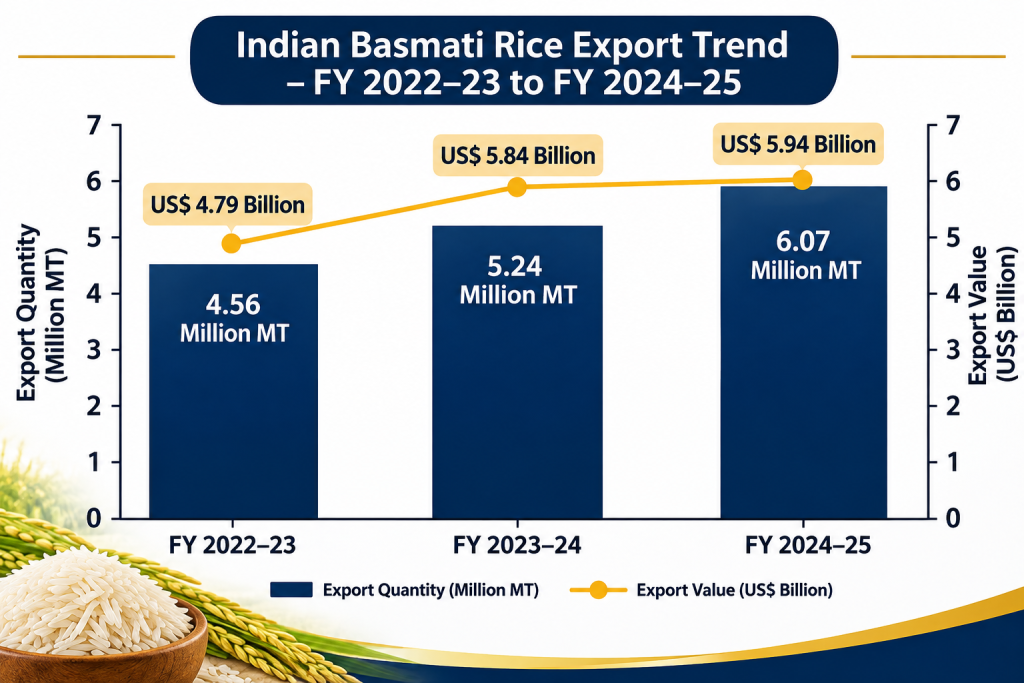
India’s overall Basmati export performance provides useful context for international buyers evaluating the market. The following figures cover all Indian Basmati varieties, not only the 1509 variety.
| Financial Year | Export Quantity | Export Value |
| 2022–23 | 4.56 million MT | US$4.79 billion |
| 2023–24 | 5.24 million MT | US$5.84 billion |
| 2024–25 | 6.07 million MT | US$5.94 billion |
India’s Basmati export quantity increased over these three financial years. Export value also rose, although its growth rate was different from the growth in shipment volume.
This trend indicates the importance of India’s Basmati trade in international markets. However, national export statistics combine different Basmati varieties and should not be treated as variety-specific figures.
Graph data:
- FY 2022–23: 4.56 million MT | US$4.79 billion
- FY 2023–24: 5.24 million MT | US$5.84 billion
- FY 2024–25: 6.07 million MT | US$5.94 billion
Conclusion
Selecting the right Basmati rice requires an understanding of processing methods, grain appearance, cooking behaviour and quality specifications. Steam, Golden Sella and Creamy Sella offer different characteristics and serve different buyer preferences.
Importers should evaluate samples, confirm specifications, agree on packaging and check destination requirements before placing a bulk order.
Mega Grain works with international commodity buyers to coordinate product requirements, quality expectations, packaging and shipment planning. Contact the team to discuss your rice sourcing requirements.
Mega Grain Offices & Contact Details
Head Office:
402, Prabhat Kiran Building,
Rajendra Place, New Delhi – 110008, India
📞 +91-11 25719896 – 97
📞 +91-9555899006
📧 info@megagrain.com
🌐 www.megagrain.com
Contact Persons
- Neeraj Dhawan
- Radhika Dhawan
- Kritika Dhawan